Channeling Huell Howser in the Eastern Sierra
The last couple of months, with the drought going on, we have been channeling his shows on the Owens River and the Eastern Sierra. He visited an amazing number of locations. (Admit it, you heard his voice when you read amazing didn’t you.)

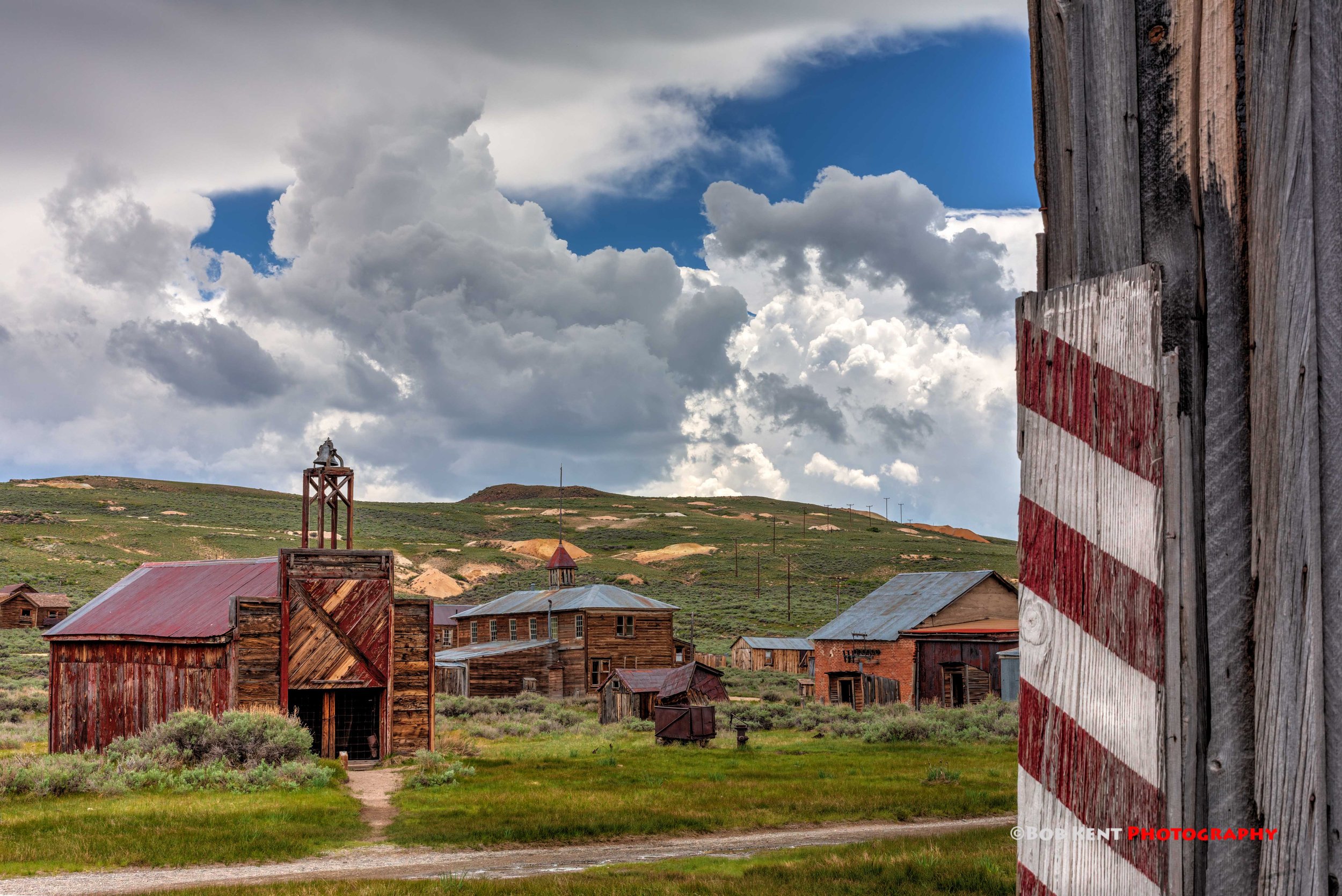
Bodie on a perfectly cloudy day!
Huell Howser once told critic Robert Lloyd that the intent of his show was to encourage viewers to “begin personal adventures into the circumstances of their place as if to turn each neighborhood joint or roadside attraction into the equivalent of the Mississippi River and to set out rafting with Huckleberry and Jim.”
My Photographer’s Assistant and I have been playing Huell’s Huckleberry and Jim for the last few years. It has been a lot of fun. If we are driving up the coast, we look for places he went to on his show. Like the Moreton Bay Fig Tree in Santa Barbara, at 80 feet tall and 576 feet wide, he wasn’t kidding when he said it was a “big” tree. Another time we searched for and found the Mission Purisima Mission in Lompoc. It is the only place left in California where you can walk on an original dirt section of the El Camino Real that the Spanish and the Missionaries used hundreds of years ago.
The last couple of months, with the drought going on, we have been channeling in on his shows on the Owens River and the Eastern Sierra. He visited an amazing number of locations. (Admit it, you heard his voice when you read amazing didn’t you.) They include:
· Bodie
· Bristle Cones
· Conness Glacier
· Devils Post Pile
· Hot Creek
· Manzanar
· Mono Lake (multiple times)
· Owens River (multiple times)
· Owens Dry Lake
· Rock Creek
· Yosemite (multiple times)
The above list doesn’t even include the multiple locations in Death Valley he visited or the Western Sierra!
I have “kind of” been to all the above locations. I say kind of because I have been in 20 Lakes Basin but not on the Conness Glacier trail itself.
This last month I have been focused on getting to specific spots along the Owens River. I wanted to find the headwaters of the lower Owens River, the start of the LA Aqueduct, and Billy Lake. It has been a lot of fun looking and along the way, I have discovered a few new spots I love.
The images in this post are from the locations Huell visited. Some of the images are from years back and my photography has improved since then. I hope you enjoy them.
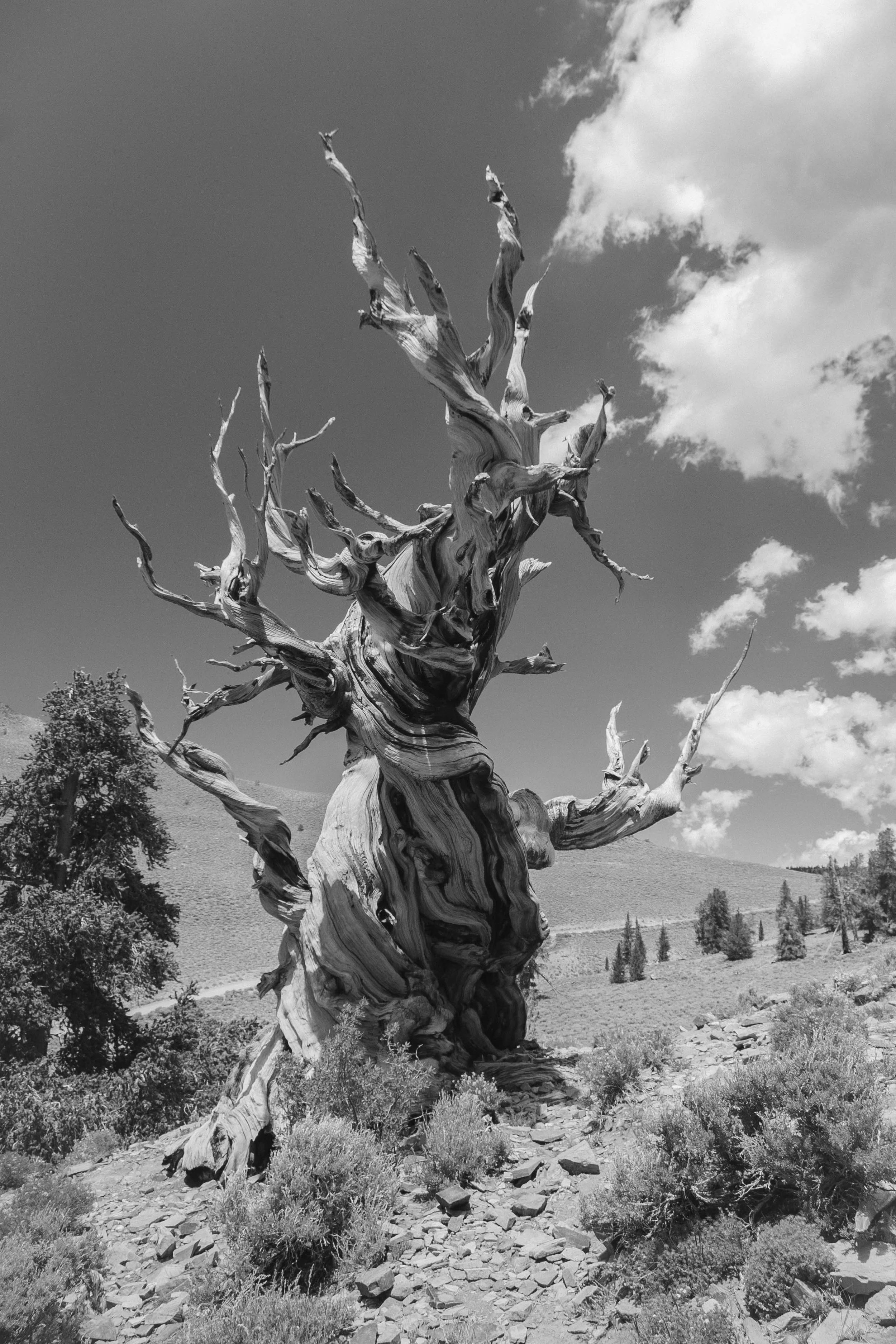
Probably the most photographed tree in the Bristle Cone groves!

Twenty Lakes basin near the start of the Connes Glacier trail head.
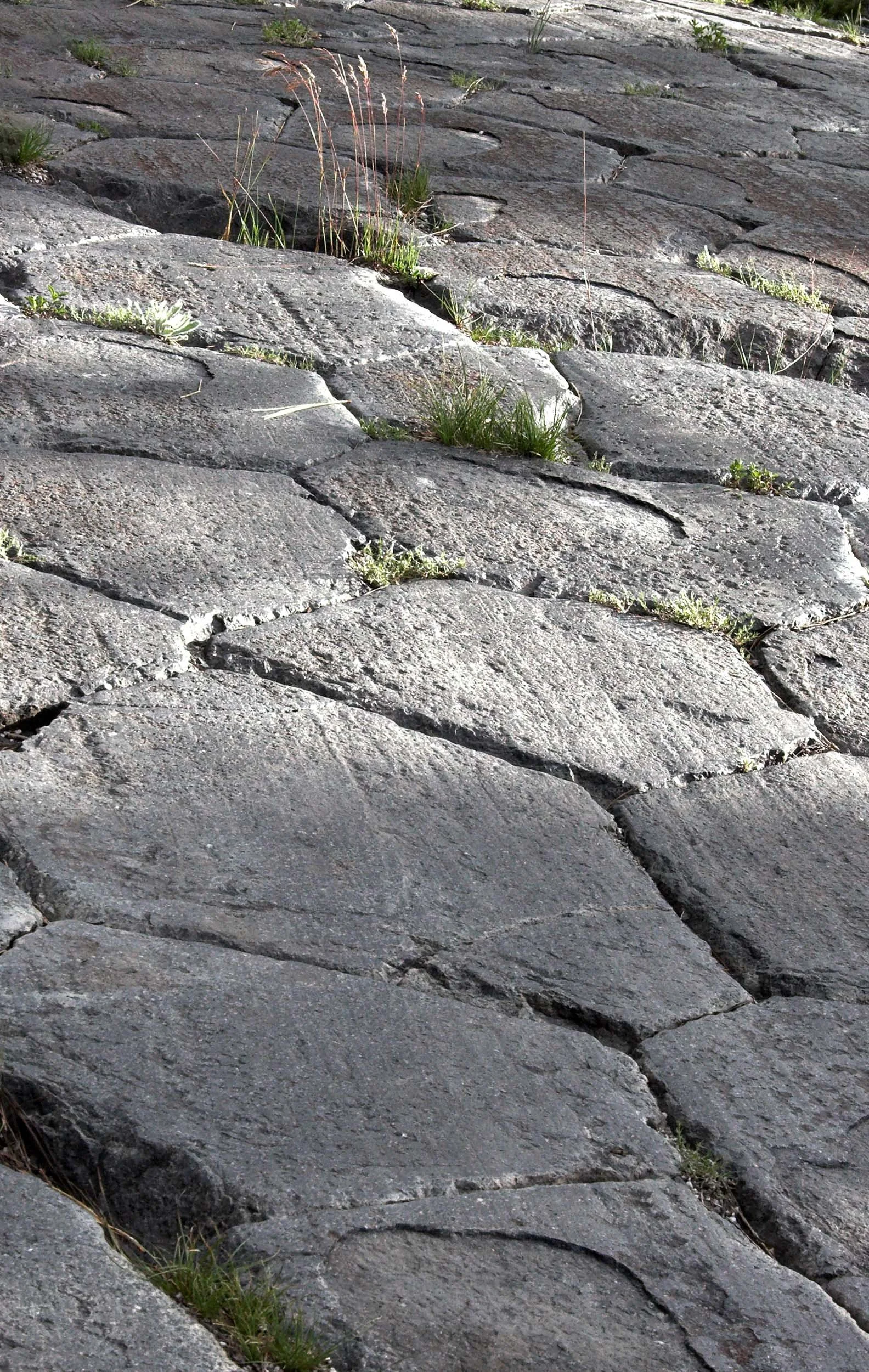
The top of Devil’s Postpile
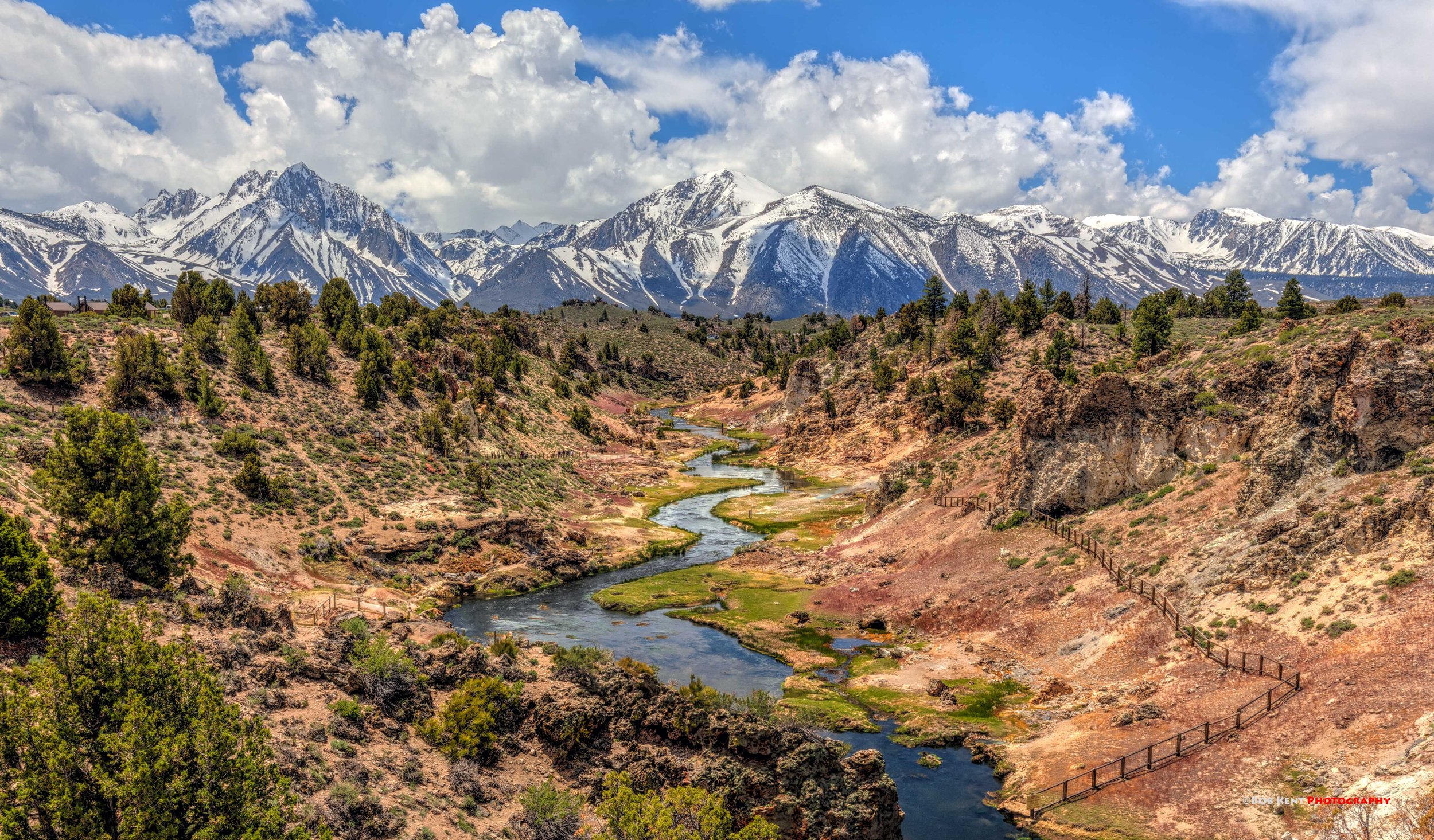
Hot Creek on an exceptionally lovely day!
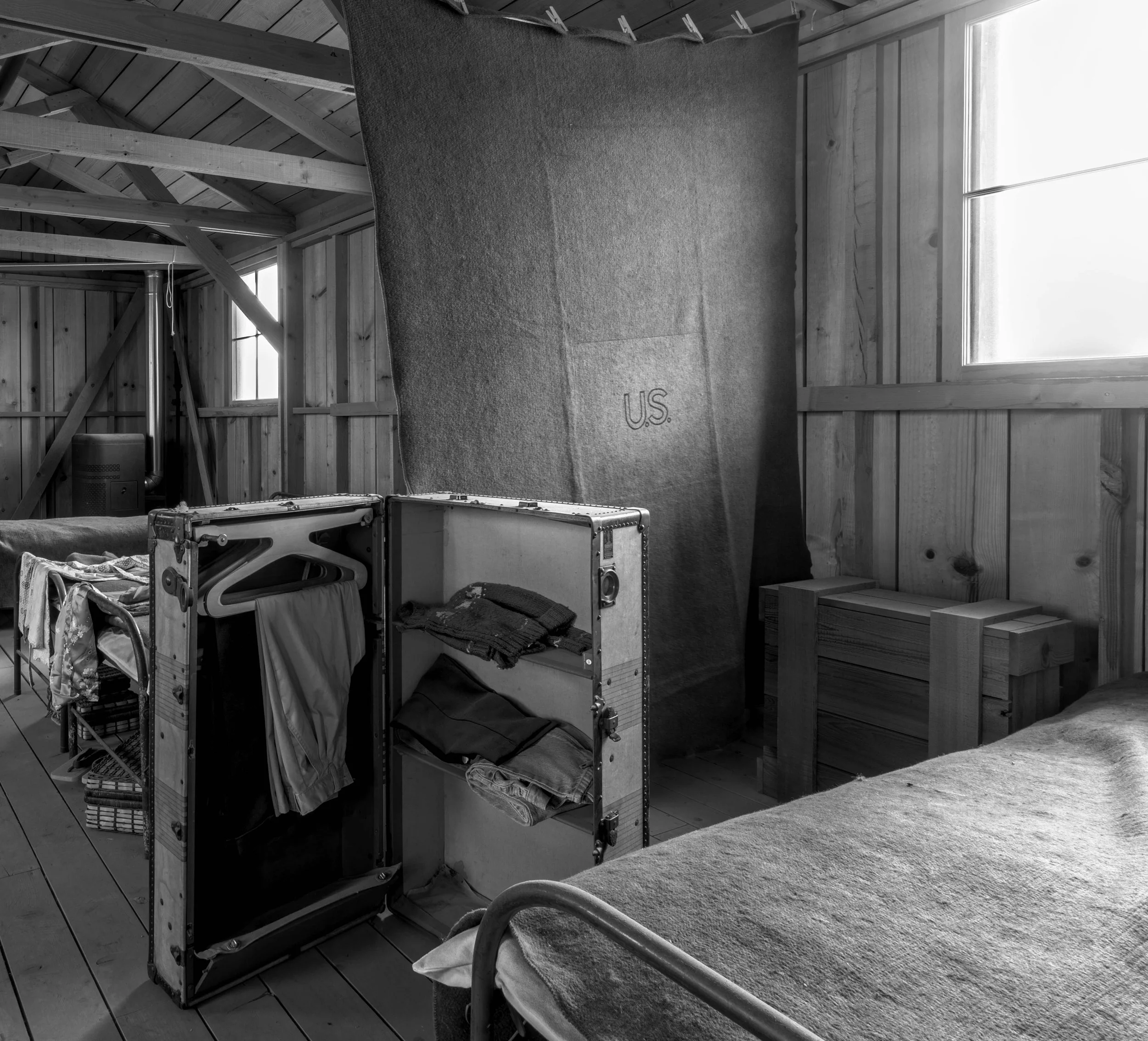
Manzanar

Mono Lake sunset spectacular

Headwaters of the Lower Owens River and Los Angeles Aqueduct. Those three inlets on the left and the water under the bridge are the start of the Lower Owens River.

Lower Owens River
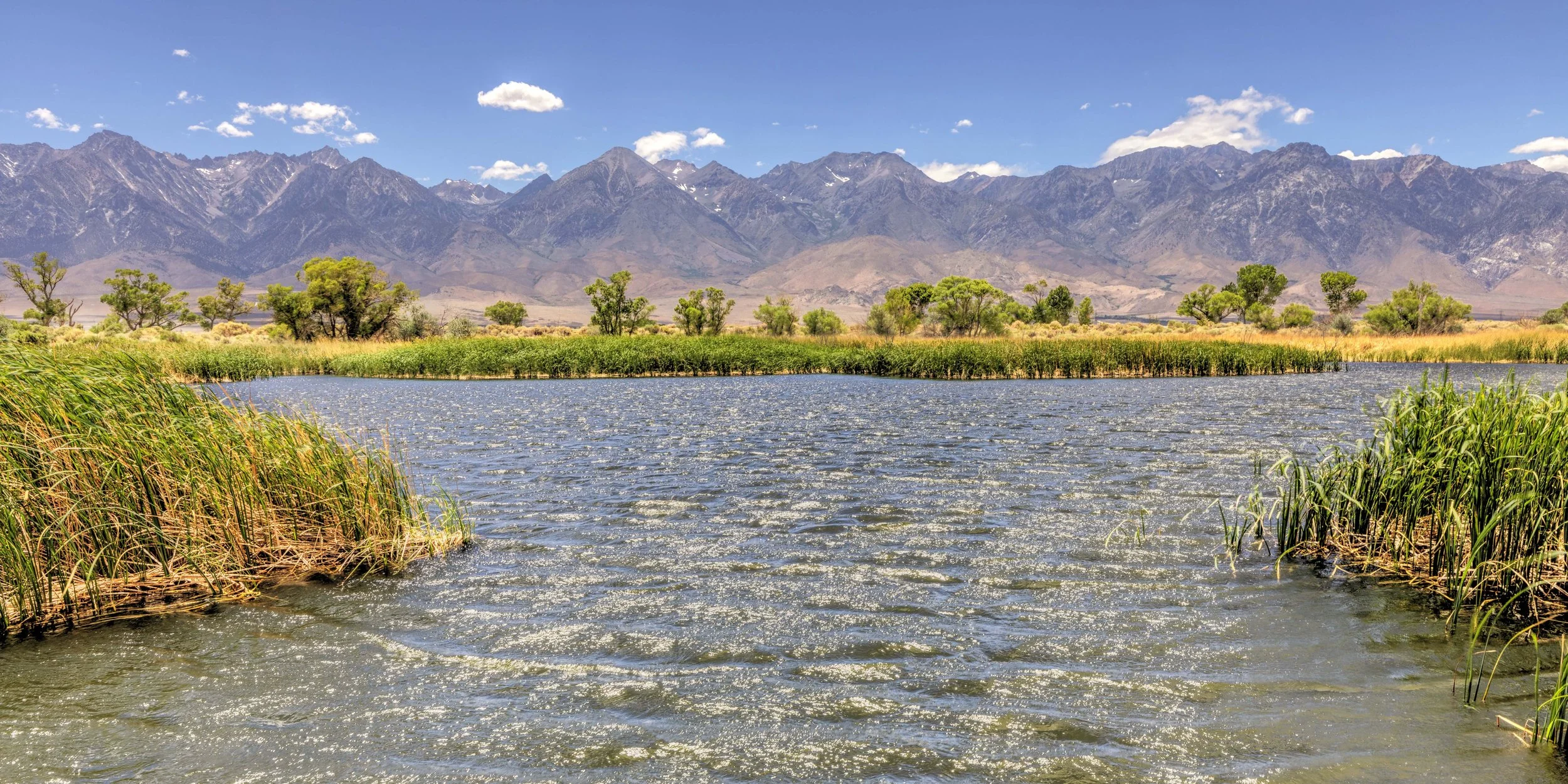
Billy’s Lake on the Owens River

Bartlett Plant - Owens Dry Lake

Lower Rock Creek
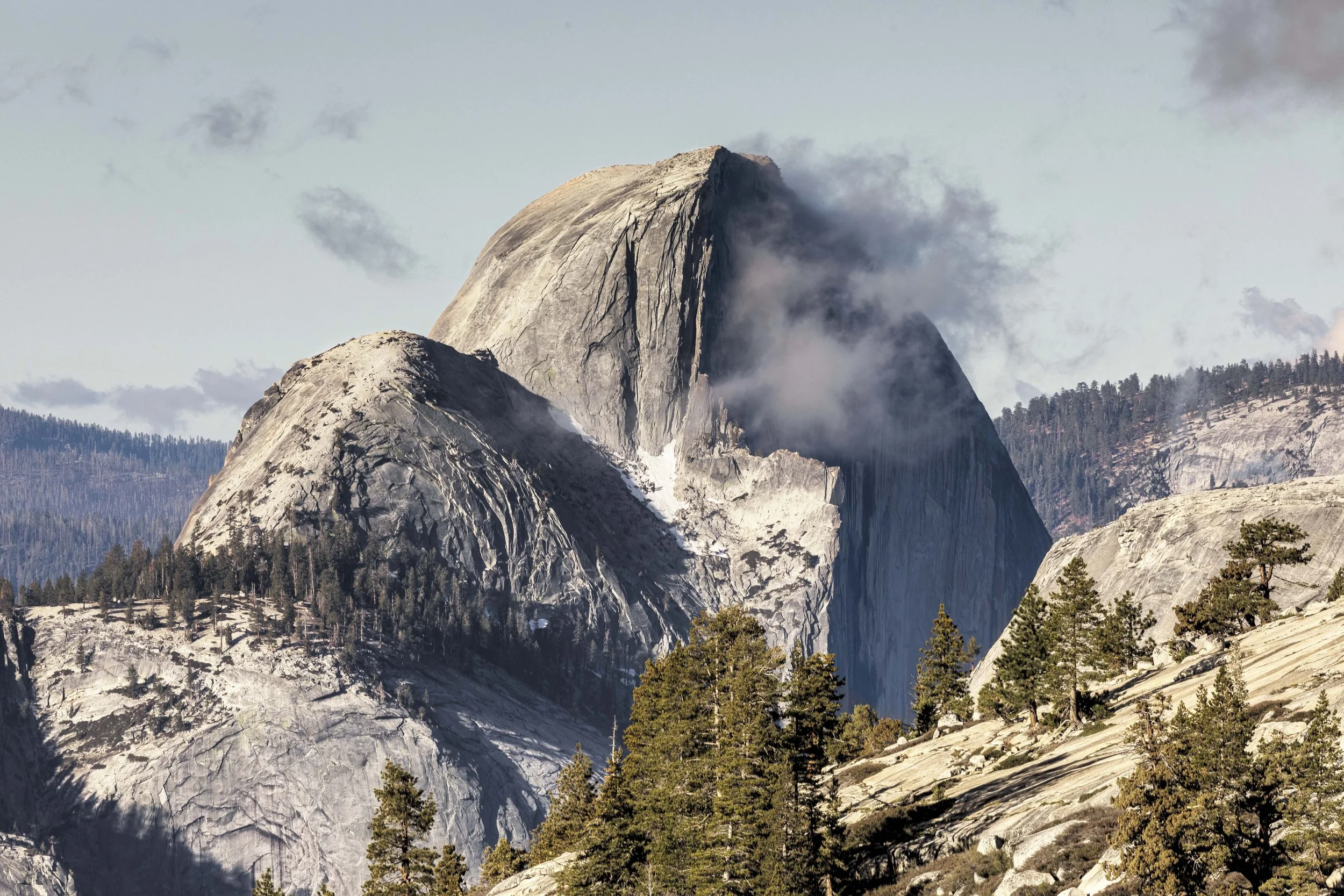
Half Dome w Clouds
Did I miss any of the shows Huell did in the Eastern Sierra/Owens Valley? The trout stocking show was in the western Sierra. Evidently, there are two Duck lakes in the Sierra.
I hope you enjoyed channeling Huell in our part of California. It just proves this part of California provides its share of California’s Gold.
If you want to watch some of the actual shows you can find a lot of them on the internet. Just google Huell Howser and the location. Or you can search the on-line archives at Chapman University
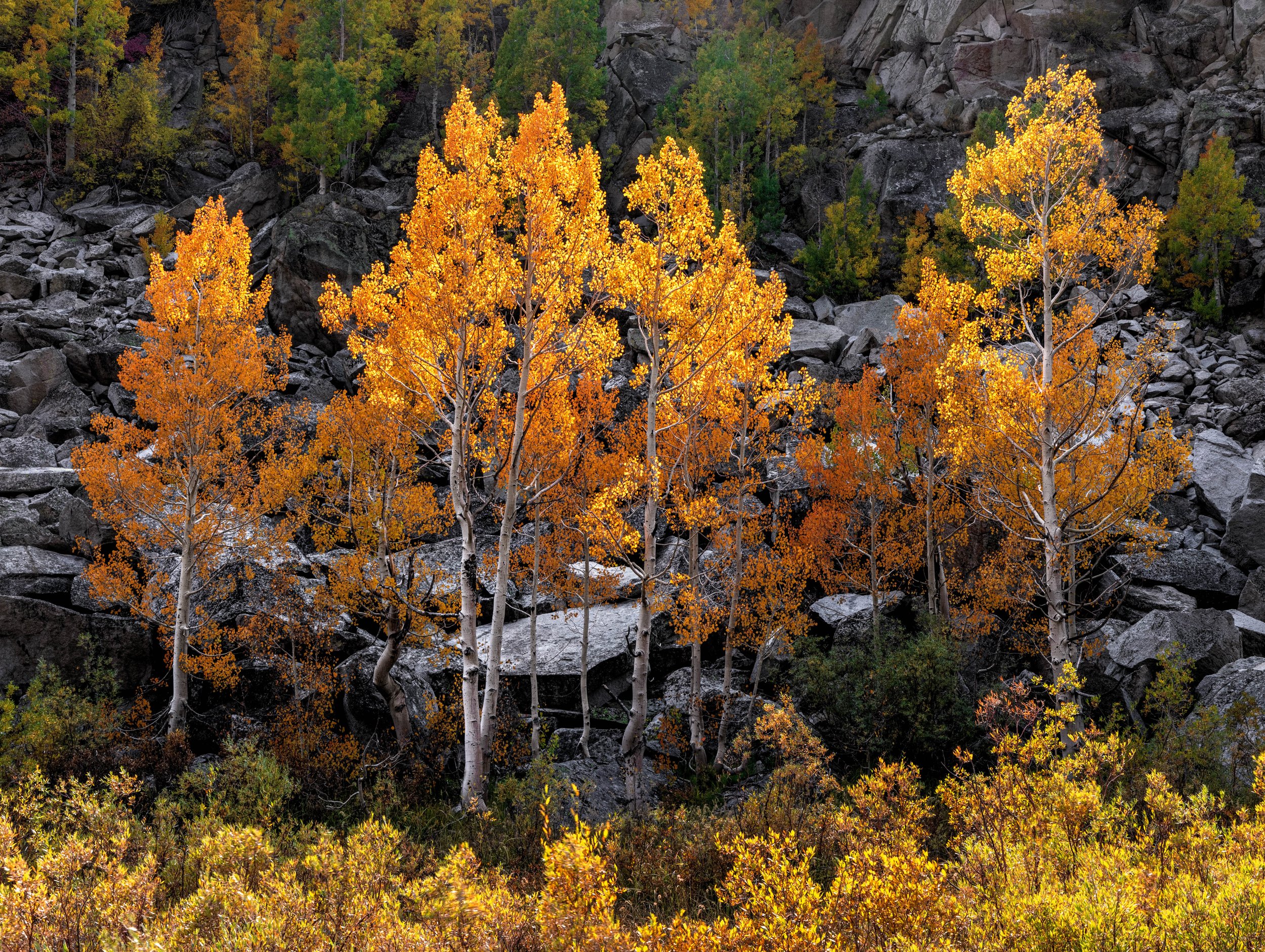
Best Images 0f 2021
My best Eastern Sierra images of 2021
It is that time of year where folks publish their best images of the previous year. Here is my list.
Locations include:
Owens River
June Lake Loop
Bishop Canyon
Bridgeport
Sage Hen
Silver Lake
Gull Lake
Mammoth Lakes
Round Valley
While 2021 had its issues it was a great year for photographing the Eastern Sierra.
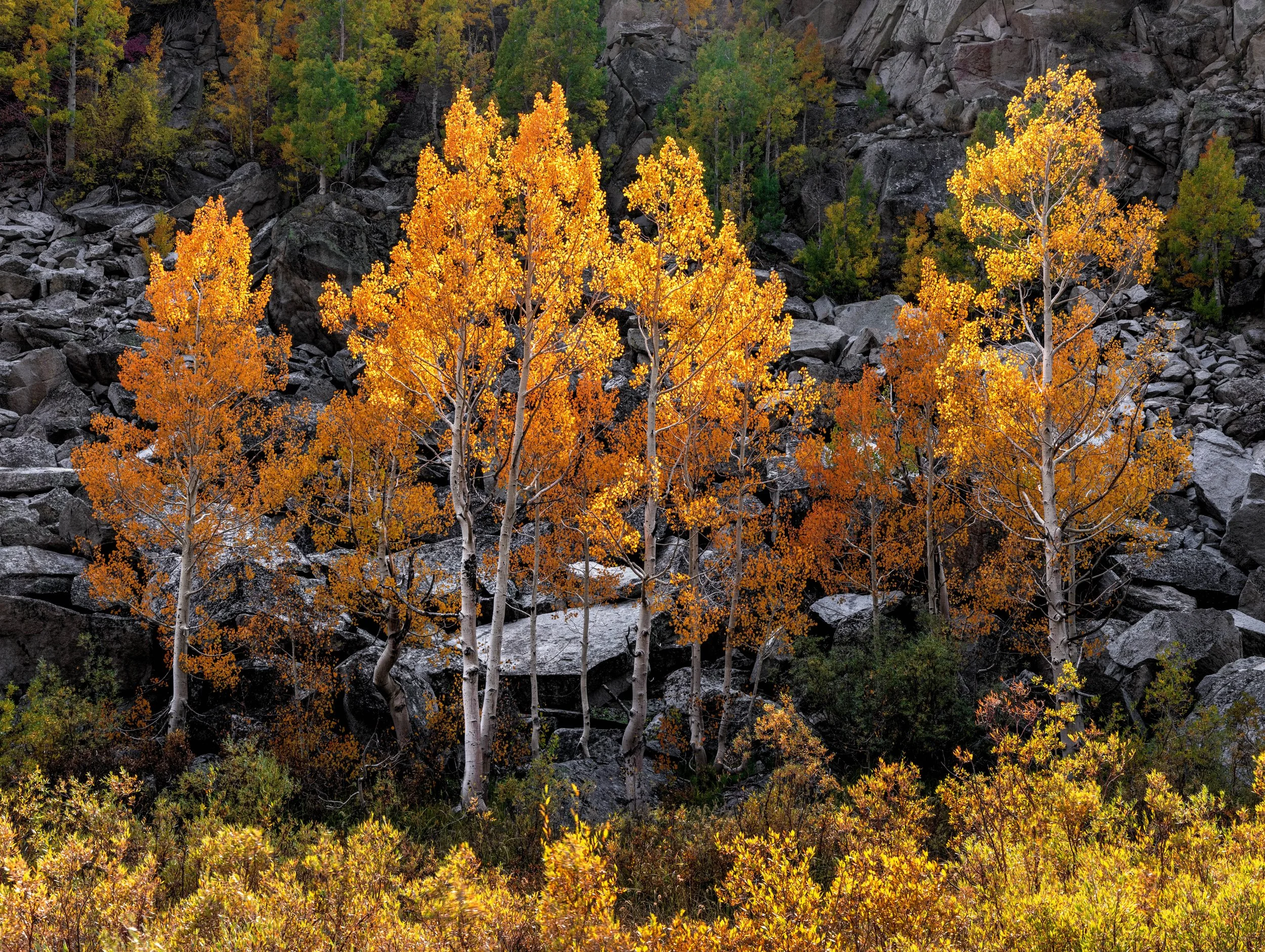
Would love to know what you think of the images and which one you liked the best.
Wishing you an awesome 2022!
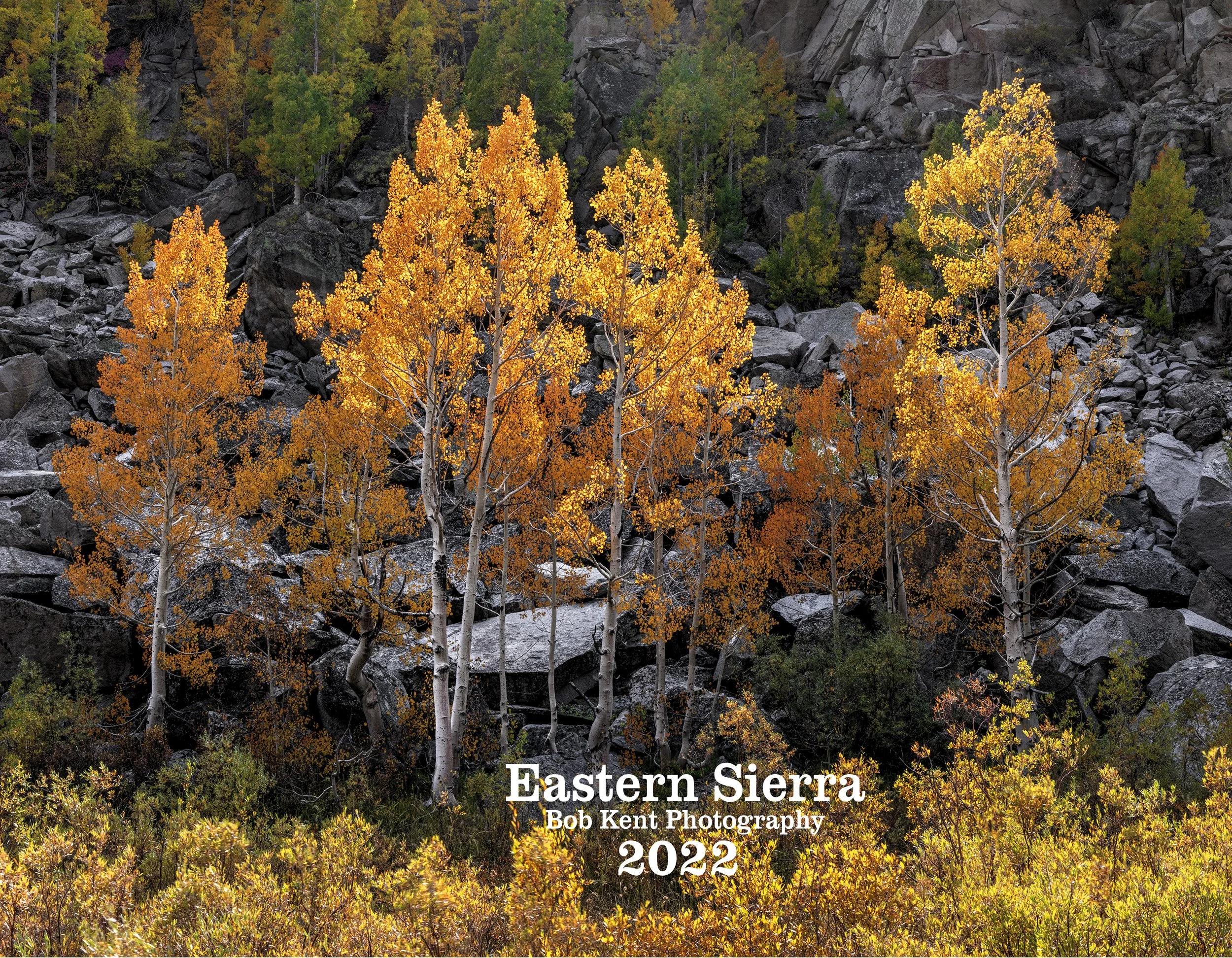
Five Reasons to Buy a Wall Calendar
With all the technology we have at our fingertips why would anyone want to buy a wall calendar these days. Think about it. We have calendars on our phones, calendars on the computer, calendars in our Email application, calendars on our watches, and even the date on our car stereo.
The wall calendar should be as dead as a doornail. Yet the more accurate phrase is “the wall calendar is dead, long live the wall calendar!” What magic gives this lowest timekeeping device alive and well?
With all the technology we have at our fingertips why would anyone want to buy a wall calendar these days. Think about it. We have calendars on our phones, calendars on the computer, calendars in our Email application, calendars on our watches, and even the date on our car stereo.
The wall calendar should be as dead as a doornail. Yet the more accurate phrase is “the wall calendar is dead, long live the wall calendar!” What magic gives this lowest timekeeping device alive and well?

Here are my top five reasons the low tech “wall calendar” thrives in this technology-driven society:
In our high-tech screen-driven world, images and information are fleeting. This creates a human desire for something physical and more permanent. We have two calendars in the house. One in the kitchen and one in the main bathroom. I usually make two calendars, one of the Eastern Sierra and one of Dodger Stadium. We catch ourselves regularly stopping and looking at the images. It takes us back to places and experiences we love.
It is like having Christmas twelve times a year. The calendar in the kitchen is too high for my wife to reach. On the first of each month, one of the first things she asks me to do is to flip the page on the calendar. She looks forward to seeing what the next image is going to be. It’s like opening a present! Some of the images have a special meaning because, as my “Photographer’s Assistant” she told me to take them!
Wall calendars bring people together. You can write something on a calendar for a specific date. From that point on everyone can see it without having to ask Alexa. We have a group of longtime friends with who we get together several times a year. With kids, sports, and work it is hard to schedule things. We have a planning party every year to map out the things we want to do together for the next year. You should see the calendars come out at that event. If you have a friend that really likes a particular topic a quality wall calendar on that topic is a great way to provide an inexpensive gift that still has a very personal touch.
I think having a wall calendar hanging up is also a character statement. Let me give you an example. In the Book Blue Highway, the author takes a trip around the US trying to drive only on “Blue” highways, meaning back roads. In the book he stated he could predict the type of meal he was about to have by the number of calendars the restaurant had on its walls:
“No calendar: Same as an interstate pit stop
One calendar: Preprocessed food assembled in New Jersey
Two calendars: Only if fish trophies are present
Three calendars: Can’t miss on the farm-boy breakfast
Four calendars: Try the ho-made pie too
Five calendars: Keep it under your hat, or they will franchise”
Now think about it. The last road trip you made. If the joint had a calendar or two, usually of a local youth sports team or a local business, the food was pretty good and the service was friendly. Now think about the last time you saw a calendar at a McDonalds. Enough said.
Well, maybe one last point for my Highway 395 friends. Our first impression of the Aberdeen Resort was a Margie standing in front of a wall calendar hanging next to a rotary phone. The food was off the chart.

Aberdeen Resort
5. The benefits of buying from a local or small-time artist that focuses on a place or thing you love.
In my case the Eastern Sierra. You are supporting a local artist. That artist will put some of that
money back into the local economy of the place you love. If that was not enough, the calendar will
bring you back to your happy place all year long.

We have several calendars up on the walls of our house. The connection between calendars on the wall and good food that the Blue Highway author makes is true. The BBQ at the Kent house is pretty tasty.
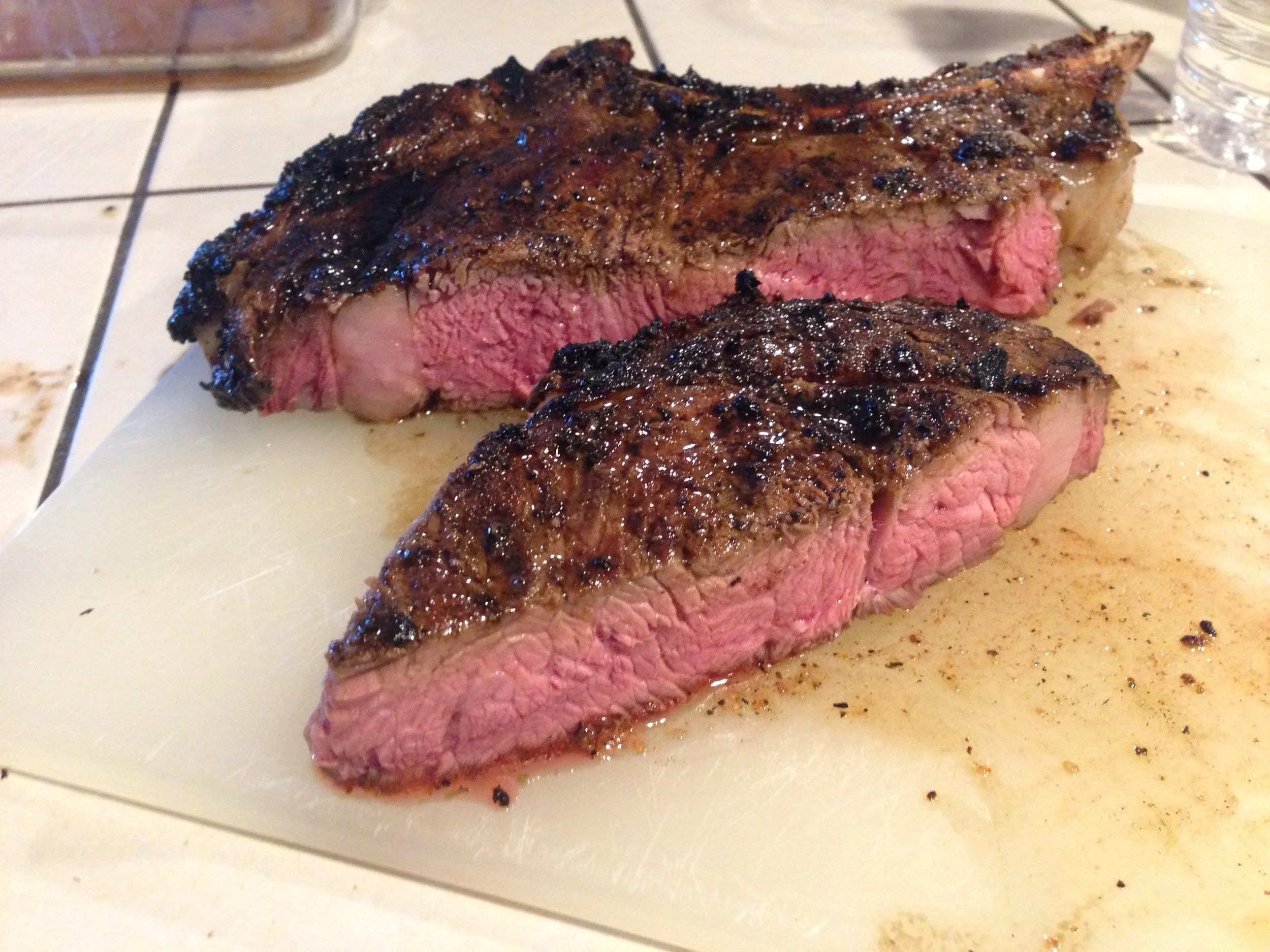
Reverse Seared Rib Eye
After reading this you have the desire to buy a wall calendar of the Eastern Sierra check out mine at the link below.
Begin 2026 with the Eastern Sierra Calendar from Bob Kent Photography—beautiful photos showing the area’s wild beauty and changing seasons. Each month displays colorful skies, tall mountains, and classic landscapes, bringing the Eastern Sierra’s charm to your home. A year-round tribute to nature’s beauty.
This year has something new. QR code that leads you to the story behind the picture!
Clouds make my Eastern Sierra Sunset Images Pop!
"Clouds come floating into my life, no longer to carry rain or usher storm, but to add color to my sunset sky."
- Rabindranath Tagore

"Clouds come floating into my life, no longer to carry rain or usher storm, but to add color to my sunset sky."
- Rabindranath Tagore
- May 2015 2
- July 2015 1
- November 2015 1
- January 2016 1
- September 2016 3
- October 2016 5
- November 2016 3
- December 2016 6
- January 2017 4
- June 2017 1
- July 2017 3
- August 2017 1
- September 2017 2
- January 2019 3
- February 2019 4
- March 2019 2
- April 2019 1
- May 2019 1
- June 2019 1
- July 2019 1
- January 2020 1
- May 2021 2
- June 2021 1
- July 2021 2
- October 2021 1
- November 2021 1
- December 2021 1
- January 2022 1
- May 2022 1
- June 2022 1
- July 2022 1
- December 2022 1
- May 2023 1
- October 2024 1
- March 2026 1
In my previous blog, I talked about how wonderful the weather was. It was doubly perfect having still mornings and cloudy afternoons. The still mornings created “glass” like conditions on the lake surface, one of my signature types of photographic images.
In this post let’s have fun discussing the cloudy afternoons we had for several days in the Eastern Sierra. Glass lakes and cloudy afternoons make for great landscape photography!
Let’s do a little bit of background on why clouds form in the afternoon near the Eastern Sierra along Hwy 395 or any mountains for that matter.
Stratus and Lenticular clouds form in the afternoon because air encounters the Eastern Sierra. The air will rise and cool. This cooler air is no longer able to hold all the water vapor it was able to hold when it was warm. The extra water vapor begins to condense out of the air parcel in the form of liquid water droplets and a cloud is formed.

Watching clouds over time is like watching a movie. The scene keeps changing as the story unfolds
Cumulonimbus and cumulus clouds form when air rises because the mountains are warmer than the surrounding air. That causes the air to rise. Once the air rises, it follows the same process to form clouds as described above.
One additional fact. Sometimes the bottom of the clouds are perfectly flat. Cumulus clouds are the type of clouds that have flat bottoms. The bottom of clouds is the exact height at where the combination of temperature and air pressure causes water vapor within the rising current to condense into a visible cloud.

“There came a day when the clouds drifting along with the wind aroused a wanderlust in me, and I set off on a journey to roam…” - Matsuo Basho
The fact that hotter temperature is involved in cloud creation would seem to explain why most of these clouds don’t hang around for sunset.
For several days, clouds would form in the afternoon and we were lucky enough that some even hung around till sunset. This creates an opportunity that my photographer’s assistant and I like to enjoy. Just find a strategic spot, set up the camera, and then enjoy the show with a bottle of wine and some snacks. It is a great way to get outside and spend a late afternoon/early evening. These evenings were no exception.
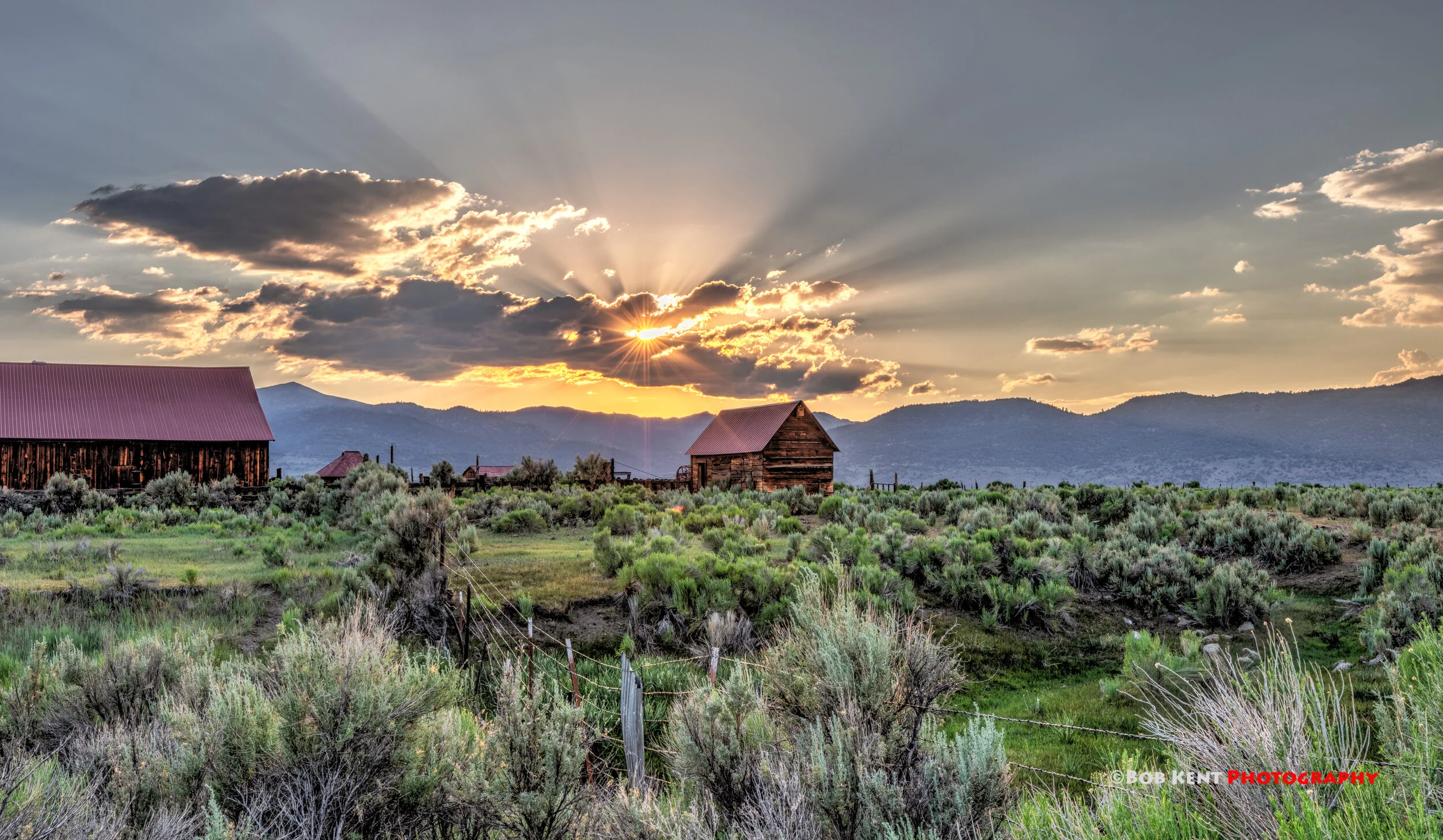
One of the nights the clouds put on a show for us was when we were waiting for the Bridgepoint fireworks on the 4th of July. The Bridgeport firework show was awesome, but I think the Sun bursting through the clouds was an equally impressive light show.

Not all fireworks are man made
I hope you enjoy the clouds the Eastern Sierra help create as much as we do! Be sure to check out my other blogs for stories and images in and around the Eastern Sierra. Feel free to share this post with anyone you think would enjoy it.
Wishing happy trials to you, until we meet again!
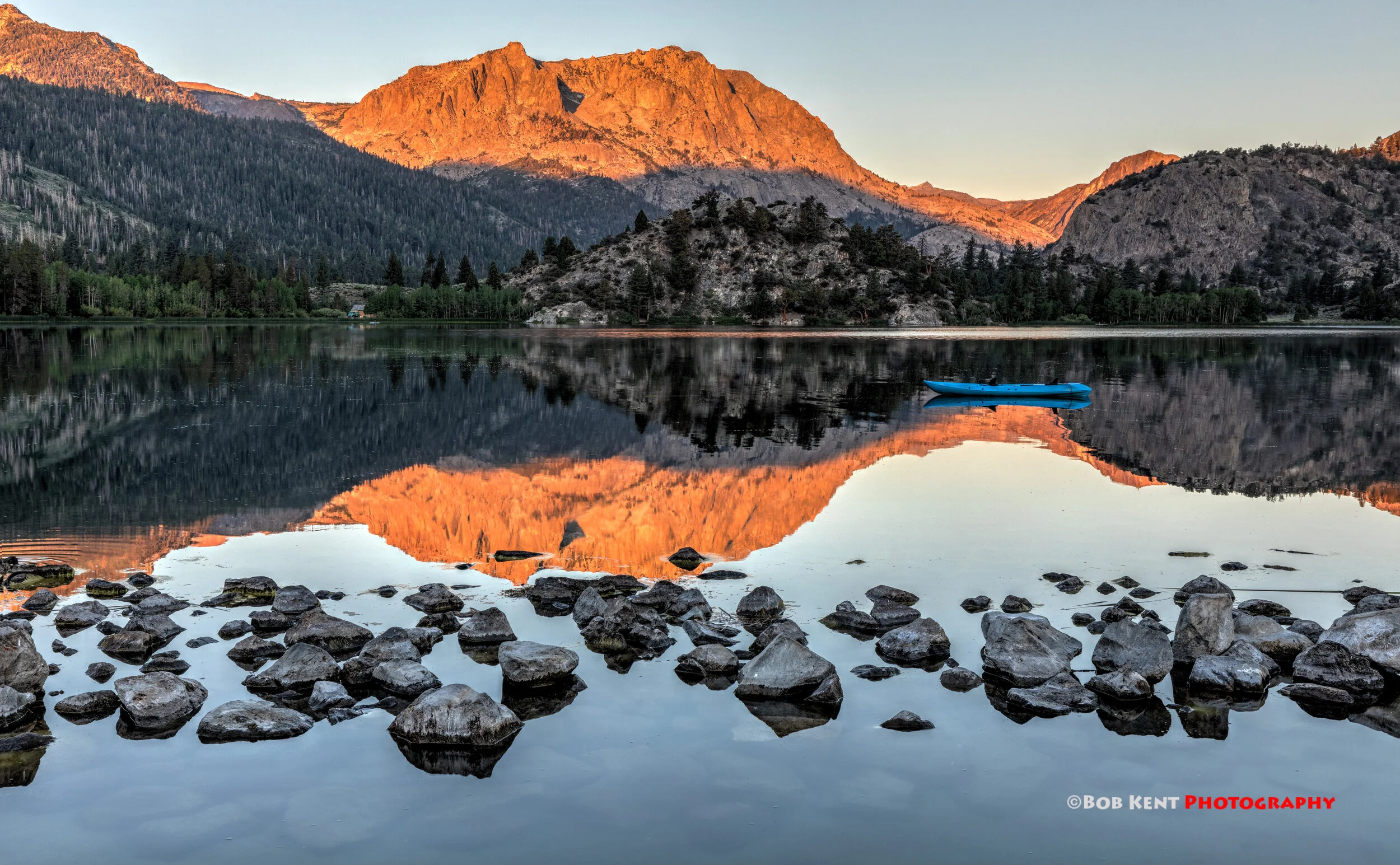
Sound of Silence
We need silence to be able to touch souls
“We need to find God, and he cannot be found in noise and restlessness. God is the friend of silence. See how nature - trees, flowers, grass- grows in silence; see the stars, the moon, and the sun, how they move in silence... We need silence to be able to touch souls.”
Mother Teresa
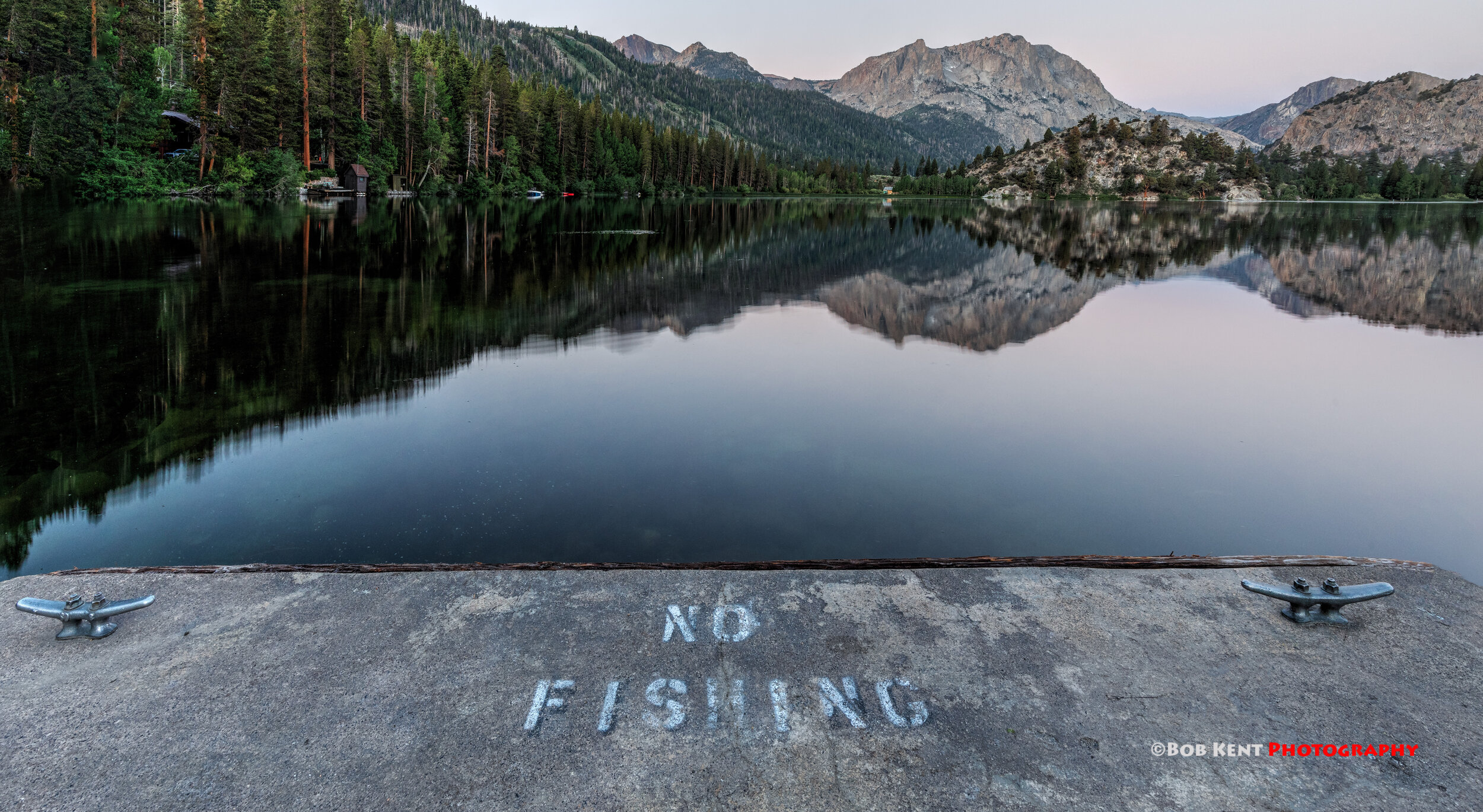
No Fishing Gull Lake
- March 2026
- October 2024
- May 2023
- December 2022
- July 2022
- June 2022
- May 2022
- January 2022
- December 2021
- November 2021
- October 2021
- July 2021
- June 2021
- May 2021
- January 2020
- July 2019
- June 2019
- May 2019
- April 2019
- March 2019
- February 2019
- January 2019
- September 2017
- August 2017
- July 2017
- June 2017
- January 2017
- December 2016
- November 2016
- October 2016
- September 2016
- January 2016
- November 2015
- July 2015
- May 2015
Typically, the 4th of July weekend Mammoth is so crowded you need to get away from your getaway. To avoid the crowds, I started to get out around 4:30 in the morning. I wanted to go out and look for sunrise images. For several days in a row, the weather was perfect for photography:
Perfectly still in the morning
Clouds in the afternoon
High clouds in the evening providing some sunset color
Originally, I was going to head up towards Sagehen because I had never been past the Aspens at the summit. With it being perfectly still I changed my plan and headed into the June Lake Loop. June Lake already had some wind so there was no chance of getting any reflections. I was thinking, oh well, at least I tried.
I headed to Gull lake and about had a heart attack. There was no water movement, no wind, no early fishermen, nothing, nada. It was just me and a few ducks. The lake was like polished glass. In fact, in some places, the reflection of the colorless cloudless sky, appeared like it wasn’t there at all.

Your transport is ready - Gull Lake
I took a few pre-sunrise images from the boat ramp figuring it would not be long before the ramp became active with fishermen. I then went onto the boat docks for the sunrise because there were some interesting foreground elements. For me, taking multiple long exposures on a floating dock requires some forethought and control. These days, I am a Covid “heavy” boy and any movement I make will rock the dock.
I had to set the tripod up, frame the composition, and then, with a wide stance, hold perfectly still for several minutes to let the dock stop rocking. I then had to touch the shutter release lightly and only move my hand half an inch away from the camera to not rock the dock.
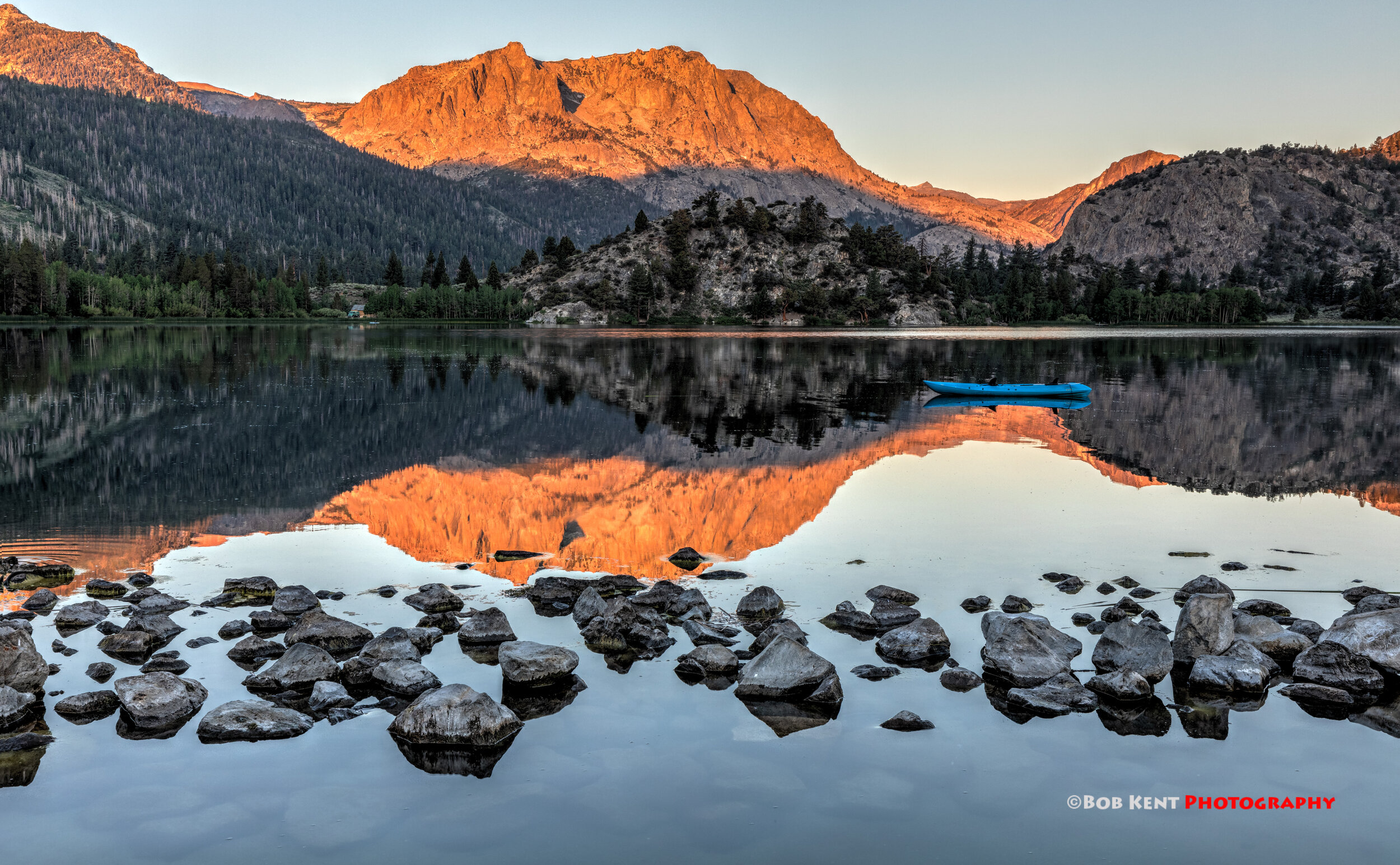
The Sound of Silence - Gull Lake
Well, the work was worth it. One of my signature styles as a landscape photographer is still lakes with glass-like reflections. In my biased opinion, these images came out awesome. I cannot wait to print these on metal.
After Gull, I went to Silver Lake and discovered it was the exact same way. No movement, no wind, no fisherman, nothing, nada. I set up to shoot Carson peak that was ablaze from the sunrise. Just as I am about to shoot this duck comes swimming into my composition. My first reaction was to shoo her off. Instead, I started to talk to her.
You see my group of close friends believes in “making friends wherever we go. I figured I would make friends with her. I asked her if she was intent on ruining my picture? She responded by standing on a rock right in front of the camera so as not to create any ripples. She kept pruning herself so I asked her if she could pose? She stretched her neck out and held perfectly still while I took my series of HDR images. I thanked her. She then did this amazing thing. She stood on one leg and spread her right wing out to show the coloring in the wing. She held that pose long enough for me to get several HDR series of her “Instagram” posing! It was like she was saying “ I am ready for my close-up Mr, Dimille.
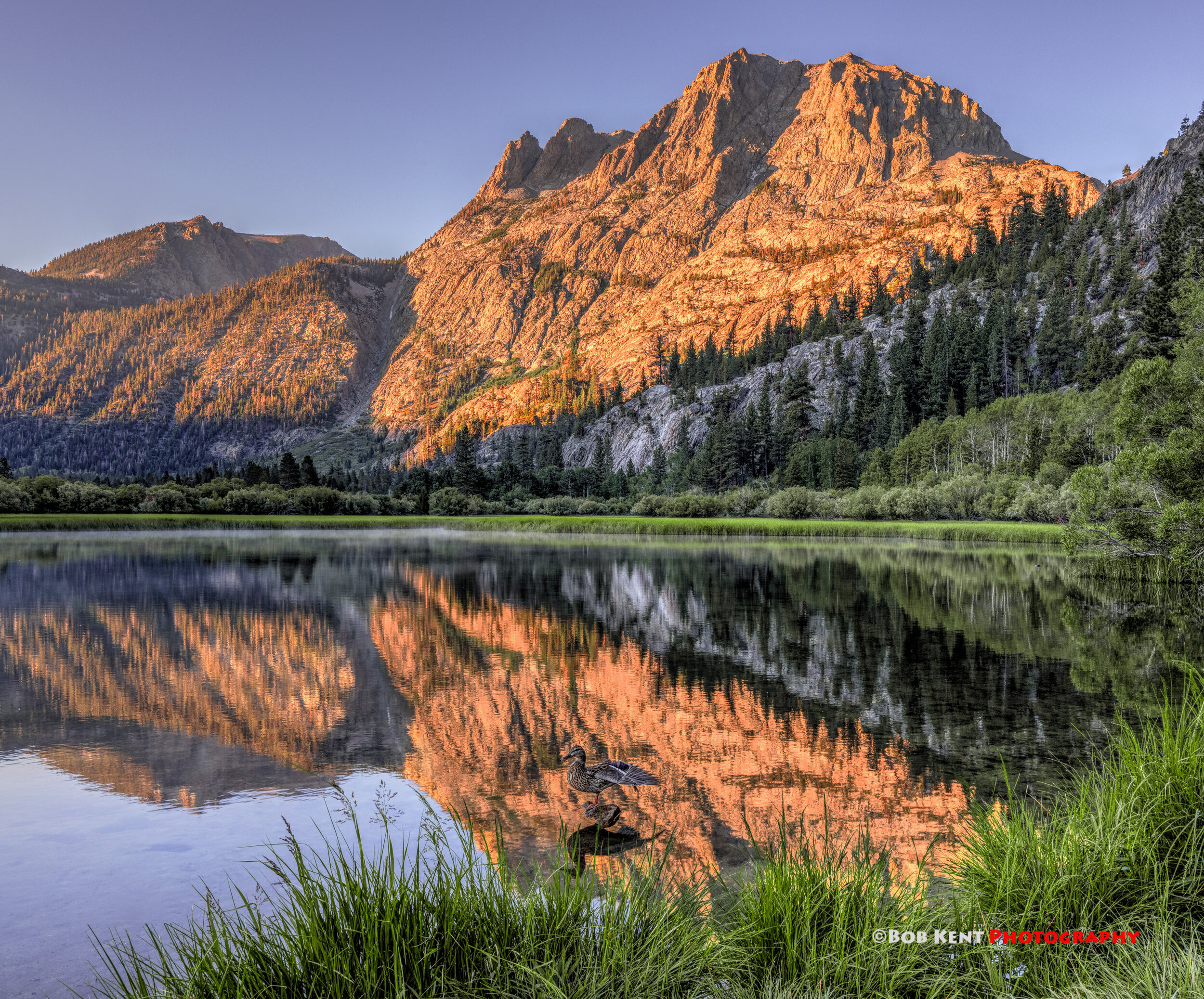
Carson Peak and my new friend

I am ready for my close-up Mr., Dimille
It was an incredible experience and I made a new friend. As Mother Teresa said in her quote “We need silence to be able to touch souls.”
My next post will be on the clouds from the 4th of July weekend. Be sure to check it out.
As always feel free to share this blog with anyone you think would enjoy it!
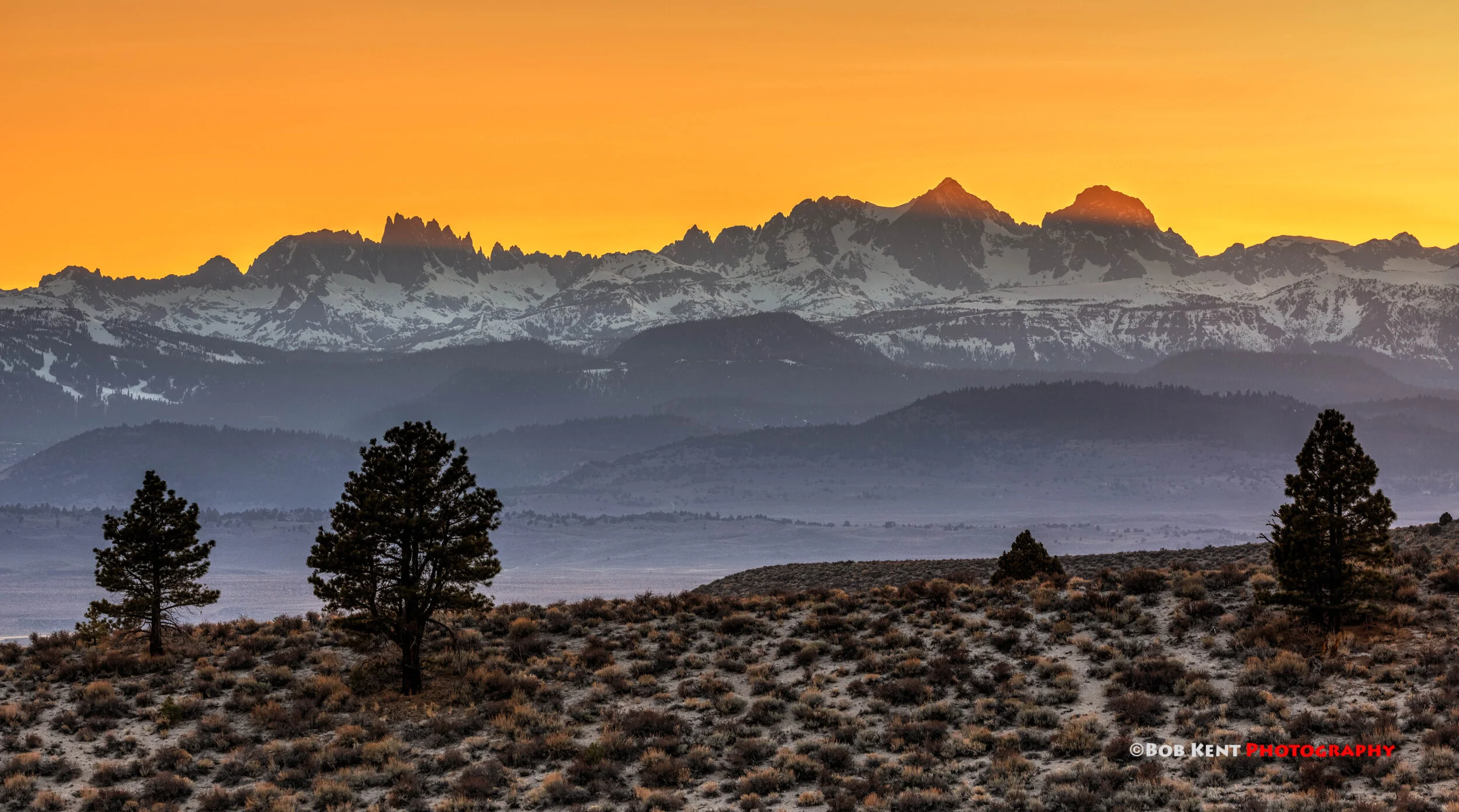
Sunrise, Sunset
“Regular mornings are for showers, coffee, catching up on the news, dressing for the day. Daybreaks are for quiet, peace, and standing on rocks to take bad selfies with the sun. Morning is responsibility, daybreaks are freedom—a smooth, blank page upon which I can write whatever comes to mind.” Gina Ryder
Sunrise, sunset
Sunrise, sunset
Swiftly fly the years
One season following another
Laiden with happiness and tears
Lyrics from Sunrise Sunset Fiddler on the Roof

Sunset over the Minarets
There is something special about sunrises and sunsets. For me, they stop time.
A few weeks ago, there were some cool clouds above Mammoth Mountain. There was a good chance they would turn color at sunset. I went out early to scout out a location because I didn’t have a go-to site in mind. I found a viewpoint that I liked way earlier than I thought I would. I set up my tripod and camera and just watched as the sunset progressed. I ended up being at that spot for around an hour and a half. To me, it seemed like only a few minutes. Sunsets and sunrises have a way of grabbing your soul and stopping time. See the scene I captured below.

Mammoth Mountain Sunset
It seems I am not alone.
As I did the research for this post, I found others felt the same way. Gina Ryder, who lives in New York, decided to try a “Sunrise Therapy” to counter her winter blues. She put to words what I feel watching a sunrise or sunset.
“Regular mornings are for showers, coffee, catching up on the news, dressing for the day. Daybreaks are for quiet, peace, and standing on rocks to take bad selfies with the sun. Morning is responsibility, daybreaks are freedom—a smooth, blank page upon which I can write whatever comes to mind.” Gina Ryder

Mono Lake Sunrise
Studies have shown that appreciation of natural beauty increases your emotional wellbeing, raisess your concern for others, and increases your satisfaction with life. If you want to experiment to see if the studies are true remember sunrises and sunsets are natural beauty at its best.
For some, making time for watching sunrises and sunsets comes naturally. For others, not so much as the pillow has magical powers to make us stay put. An article on the Psychology Today website gave some tips to help you develop your sunrise/sunset watching skills:
· Grab a camera or sketchpad. The goal is to really see the sunset and capture the moment-to-moment experience, not create an artistic image.
· Make it a meditation. Take several slow, deep breaths to relax your body and calm your mind. Then intentionally focus on the sunset, noticing how the colors and light change as the sunset first builds in intensity and then fades.
· Listen to music that thrills you. If you’re more attuned to sound than sight, use music to put yourself into a receptive state of mind.

First Light
Nature gives us these sunrises and sunsets freely. There is one of each every single day. I highly suggest you take some time to enjoy these gifts. They will do you good!
I would love to hear what your most memorable sunrise/sunset experience is.

Thanks for taking the time to read this post. Feel free to comment or to share it with others!
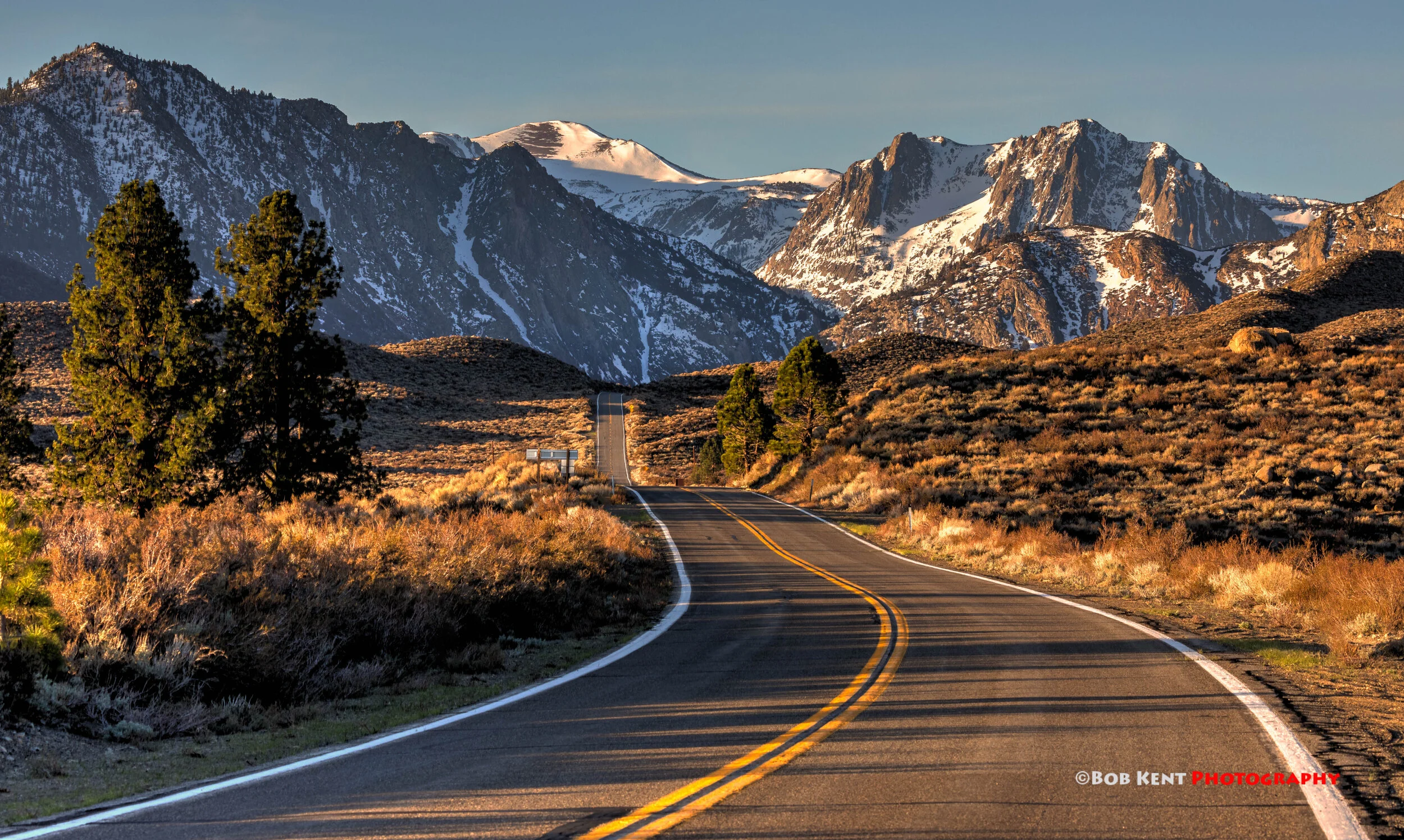
Early Morning Around the Loop
It is so beautiful and diverse you cannot go wrong taking images in the “Loop”. Plus, people who love the area never get tired of looking at images of the area. I guess the old saying applies; “When in doubt…” head towards the “Loop.”
The June Lake Loop is the gift that keeps on giving for a landscape photographer who focuses on the Eastern Sierra. It is so beautiful and diverse you cannot go wrong taking images in the “Loop”. Plus, people who love the area never get tired of looking at images of the area. I guess the old saying applies; “When in doubt…” head towards the “Loop.”
This early morning, I originally intended to head out east on Highway 120 to explore parts of Sage Hen that I have not been at yet. Driving north on 395 I realized I had gotten on the road too late to get there before the sunrise. There was now this debate in my head between keeping to the plan and turn right on HWY 120 or go to plan “B” and turn left on HWY 158 and go into the “Loop.” The voices in my head kept arguing Plan A, no Plan B, no Plan A…

The Tail of the Isthmus - Grant Lake
With the title being “around the Loop” you can guess that I went with plan “B” and turned left into the “Loop.” There is a small isthmus on the north side of Grant Lake. It has this grand view of the lake and Reverse and Carson Peaks. I have taken pictures there before but was not completely happy with the results. I went back to the isthmus. I arrived early enough, trying not to wake up the folks sleeping in the van, to be able to poke around a bit to find the perfect spot for sunrise.

Looking East at Grant Lake
With my composition locked I had some time on my hands. As the scene unveiled around me, it presented some additional looks that I was able to capture before getting my sunrise image. It was cold with just a touch of wind to wipe out the chance of a glass reflection from the lake. However, it was still enough to project the colors from the mountains.

First Light - Grant Lake
On the way back to 395, I noticed this awesome road scene so I quickly pulled over and changed to my telephoto lens. I am so glad I did, just love this scene.

Looking West into the June Lake Loop
All in all, a nice set of images for a plan “B.” As I said earlier you really cannot go wrong taking images around the “Loop.”
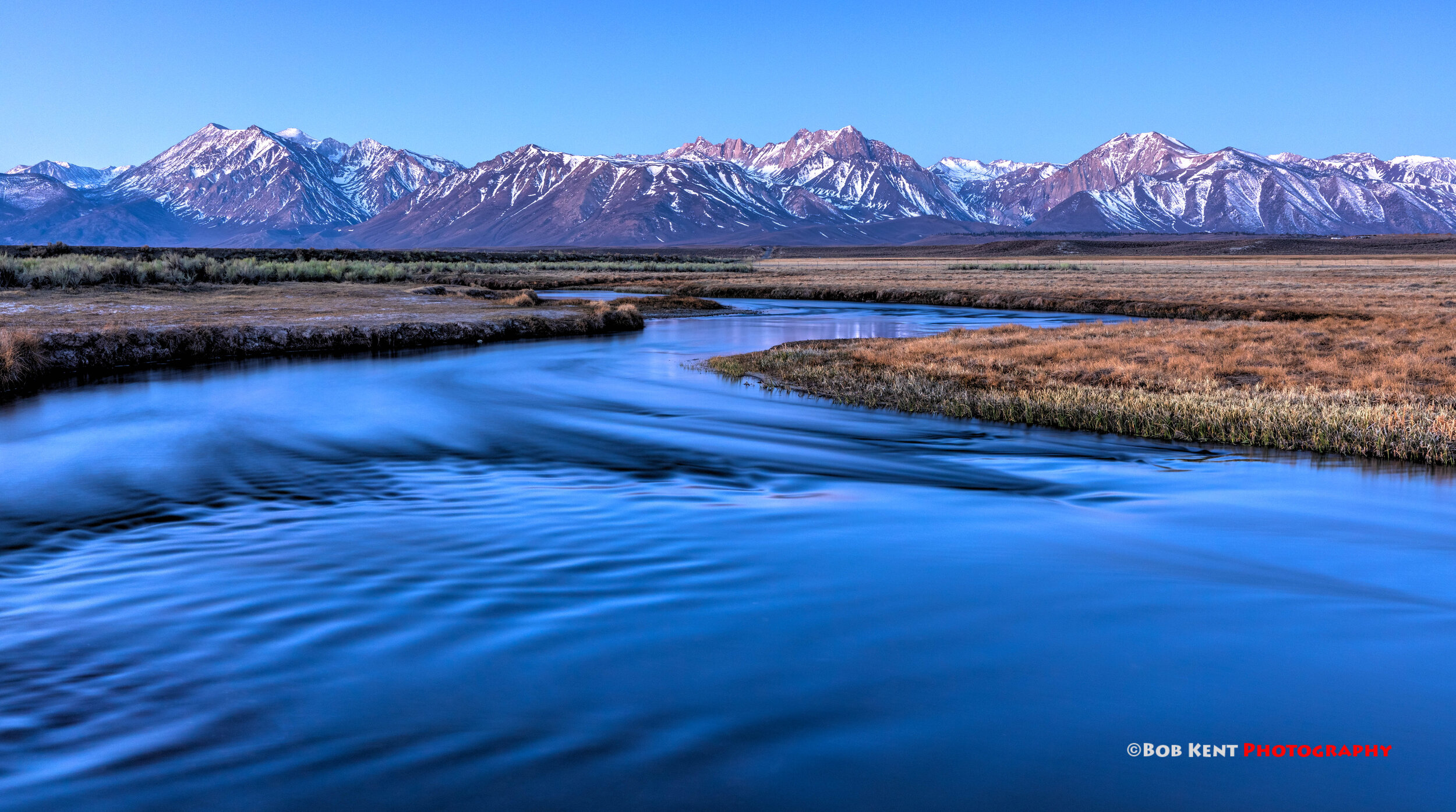
The Case for Lingering
Getting to a location early and lingering afterward lets you see this incredible transition from darkness, to blue, to gold, and then finally to daylight. The same scene can look totally different and tell a completely different story, all within an hour. Same place, same stream, or trees, or mountains yet in a matter of a few minutes it “feels” totally different.
I was watching a landscape photography video from Roman Kurywczak called “For the Love of Landscapes.” In the video, he reminded me that to be a good landscape photographer you must have discipline.
Specifically, the discipline to get to a location early and stay late. To linger.
For a sunrise, you should get there an hour before the sunrise and stay for an hour after the sunrise. This is not a message I like to hear, as it means getting up at 4:00 AM or earlier to get to a location in time. However, it is a message that I need to hear regularly because he is right, and it is worth it.
He is right because a lot of the beautiful magic happens well before and after the actual sunrise. Roman correctly points out, if see something happening before you are there, you have already missed it. Unfortunately, I know this from experience. Countless times seeing the clouds turn while driving to a location and knowing no matter how fast I drive I am too late.
Getting to a location early and lingering afterward lets you see this incredible transition from darkness to blue, to gold, and finally to daylight. The same scene can look totally different and tell a completely different story, all within an hour. Same place, same stream, or trees, or mountains yet in a matter of a few minutes it “feels” totally different.
You don’t have to be a photographer to enjoy this. If you go to a location, especially in the afternoon, take your time. Linger.

Owens in Blue
There is a transition that is worth the price of admission to watch. At a lake, many times, the transition follows a pattern. In the afternoon it mostly calm with flat colors, then just before sunset the wind kicks up, the water is choppy, and the colors have this golden cast. It is the day taking its last breath. Finally, after the sunset there is this stillness that descends upon everything. The water goes still, it gets quiet, and if you’re lucky the high clouds catch on fire with yellow and oranges.

Owens in Purple
To experience this, you don’t have to move locations you just have to linger in one place for a while. While sometimes you get duds, many other times you get one heck of a show.

Owens in Gold
The series of images in this post of the Owens River in the morning transition is a perfect example. If you want to see another incredible transition at Lake Tenaya, message me.
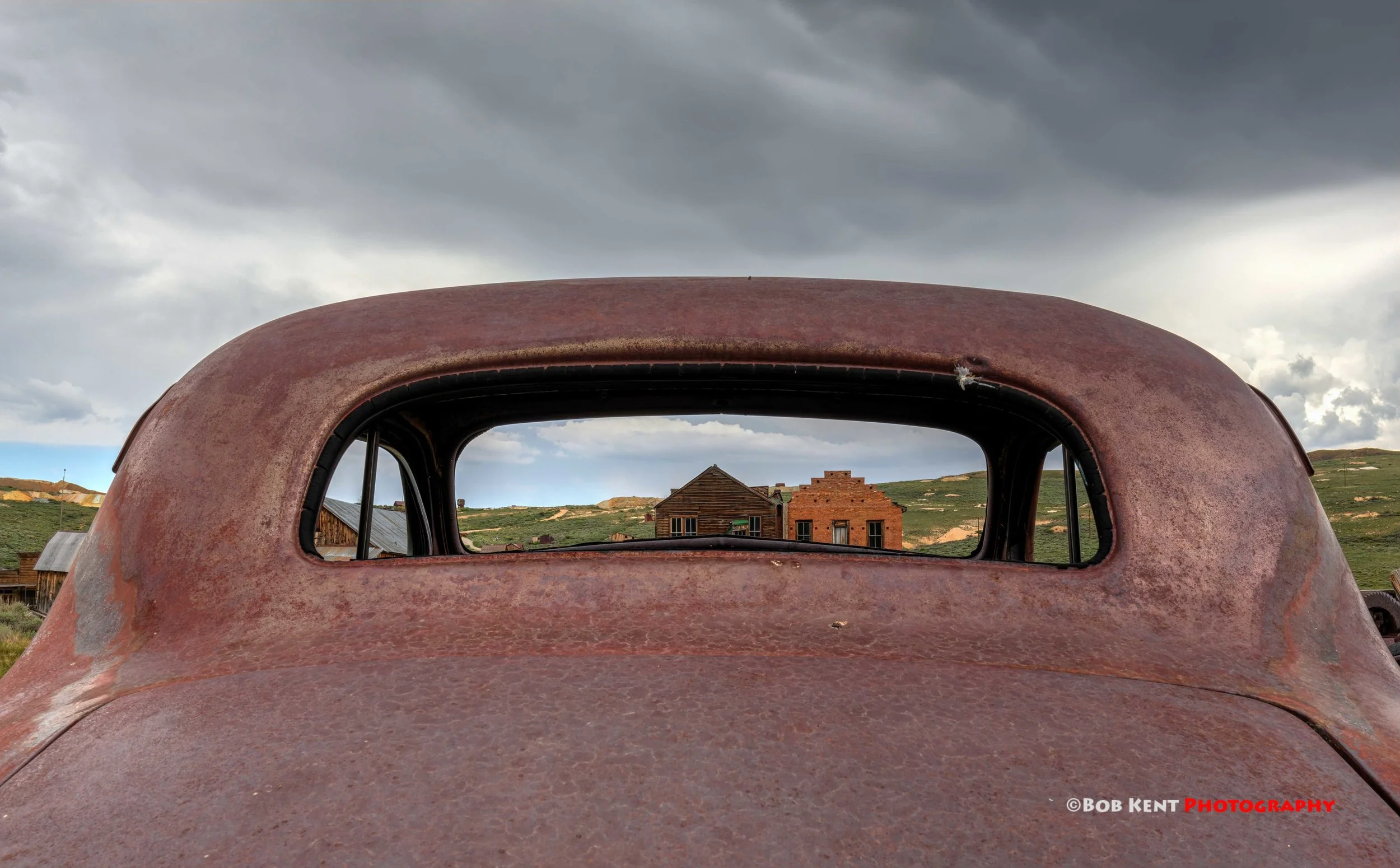
A Different Take on Bodie
Instead of taking images that were documentation in nature, I wanted to have my images tell a story. A story about what it must have been like to live in a rough town with hostile environment. Nature gave me a bonus by providing this incredible cloud show the day we went to emphasize the hostile weather.

You can be civilized but not very civil. Despite having all the institutions of of a modern city: Barber, fire department, and a school Bodie was a rough town that was not very civilized.
I am teaching a composition photography class in September at the Mono Arts Gallery. In researching the material for the class, I have learned a lot of new composition concepts that are having a positive impact on my own photography. When we had a friend come to Mammoth who had never seen Bodie it gave me the perfect reason to go and to look at Bodie differently than in previous trips.

Porch with a view. What amazing stories this porch could tell!
Instead of taking images that were documentation in nature, I wanted to have my images tell a story. Stories about what it must have been like to live in a rough town with a hostile environment. Nature gave me a bonus by providing this incredible cloud show the day we went to emphasize the hostile weather.

Sometimes there is only a thin pane of glass that protects us from the harsh elements. An analogy that our society is fragile and could come crashing down with all the heightened tensions in our world today.

If you look back too much you can get stuck in one place and become a relic.
As I researched for this blog post I wanted to include some interesting Bodie trivia to go along with the images. Just like my attempt of changing the composition nature of my photography my research netted me a different take on Bodie. Instead of a lot of fact and figures about when the town was started or how much silver was mined I found this story about the “Curse of Bodie.”

Live a good story. Could you use any of this stuff today? A reminder that it is not the things we own that are important but the experiences we have.
You would expect the curse to be about the ghost of some innocent who was killed by a gunfighter or some small child that died too young from disease. Instead the curse is a modern day invention “created” for a specific purpose just like the town’s name. The town’s name was changed from Bodey to Bodie so people used the correct pronunciation. (A much more fun theory is that an illiterate painter misspelled Bodey as Bodie on the side of a building and the misspelling became the defacto official name of the town.)

Look at your everyday world as if it was art. You will be a much richer person for it.
The town’s name was created from a necessity. So, did the “Curse of Bodie.” The State of California keeps Bodie in the state of “arrested decay.” What that means is the State tries to keep the town looking exactly like it did when people abandoned it. They will do repairs but only to the extent to keep it looking like it did when folks left. If the building is leaning they will fix the roof or keep it from leaning more but won’t try to straighten the building up. Here is where the invention of the “curse” came in.

Man vs. Nature. Nature always plays the long game and In the end will prevail.
In this arrested decay condition there are artifacts that were randomly left everywhere. When people left they had to travel long distances and did not have the capability to take things with them. Dishes are still by a sink. An oven door is outside leaning against a building. In that environment visitors have a natural desire to take a souvenir. One item missing is no big deal but with thousands of people visiting Bodie every year lots of stealing would have a major impact.

In your life build a safe heaven to provide shelter in the storm. I have found the best shelters from life’s problems are good friends.
Somewhere in the past a few rangers “created” the “Curse of Bodie.” They said that if you took an artifact, rock, or anything from the site you would be cursed from then on with bad luck. They thought the story of the “curse” would deter folks from taking stuff. While it has kept folks from stealing, something else happened. People who did take artifacts blamed bad events that happened to them on the curse. Rangers get letters every week from folks who took items from Bodie that blame the “curse” for breakups in relationships, the deaths of family and friends, even simple things like flat tires. Some go as far as to send the item they took back to the park in hopes of lifting the curse.
"Please find enclosed one weatherbeaten old shoe. The shoe was removed from Bodie during the month of August 1978... My trail of misfortune is so long and depressing it can't be listed here."
Letter to Bodie, undated

Some of the most beautiful paintings are right in front of you. Take the time to stop and enjoy.
Today the Rangers no longer like to speak of the curse because if someone does send something back they have to treat it as a theft and file charges. Not something they really want to do. Besides once an item is removed it loses its historical context that cannot be regained. An example is a piano that was taken and then returned. No one knows what bar or house it came from. It now sits in the town hall like an orphan who does not know where she came from.

Get outside and into the world around you. It is much more colorful than being cooped up inside.
Please enjoy my visual “different” take of Bodie. Enjoy Bodie when you go but remember the “curse of Bodie.” It may be made up but lots of people believe the bad luck of the Bodie “curse” is very real. Let the artifacts lie where they are so others can enjoy them for many years to come.

Bodie is so mean it will even spit at you (rain) on you when you leave.
Please leave comments to let me know if I succeeded in creating a different take on Bodie than you have seen before.
Source Article about the Curse is from KQED see it here.
If you are interested in taking my Photography Class it is on September 28th in Mammoth from 3-6. On the 29th we will do a group photo safari in the morning to put what you learned in action. Sign up here.
Heaven
A few years ago, I experienced a drought of clouds for what seemed like an eternity. Every time I went on a photo expedition it was nothing but blue skies. It was frustrating as I love clouds in my landscape images. Well this spring ended the cloud drought in a spectacular way!

Spring or 2019 - Wildflowers, snow, and winter that won’t go away!
A few years ago, I experienced a drought of clouds for what seemed like an eternity. Every time I went on a photo expedition it was nothing but blue skies. It was frustrating as I love clouds in my landscape images.
Now the cloud “drought” was not all bad as any day in the Eastern Sierra is a good day; with or without clouds. The lack of clouds forced me to experiment with new compositions and subjects which made me a better photographer. In the end I still wanted clouds.
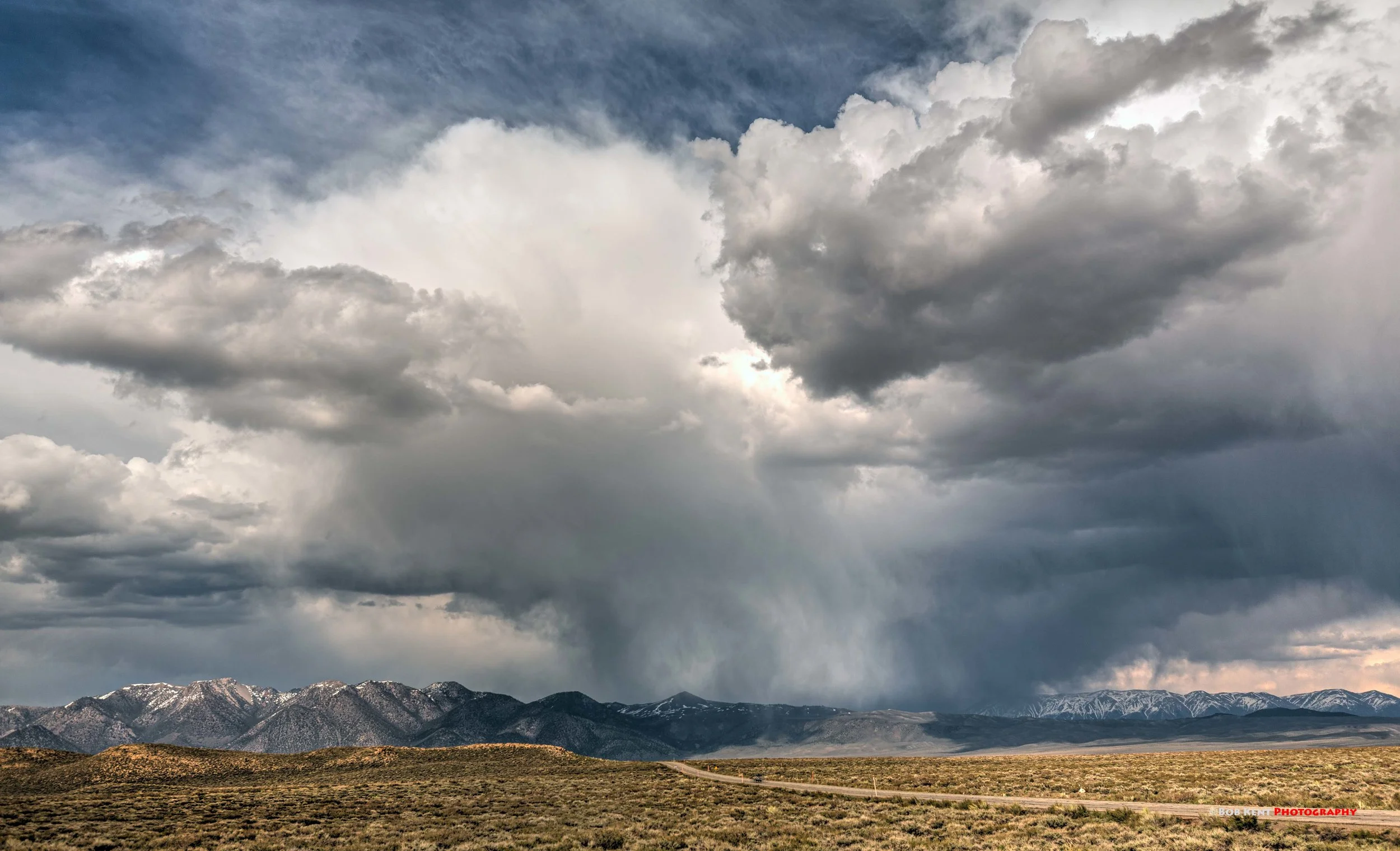
That is were we are heading to!
I am here to say with the Spring of 2109 my cloud drought is over. The last couple of meanderings has been off the charts. There were clouds, and I mean awesome clouds, everywhere you looked. They weren’t high clouds, so they didn’t go orange and red at sunrise and sunset, but it didn’t matter. Their size, complexity, brutishness made them totally photogenic. The main key to getting great images was to just get out there, and stay out there, capturing the clouds as they morphed throughout the day. All the while I was in heaven.

The road and clouds inviting us to explore!
I am doing research on a photography class I am going to teach at the Mono Arts Council in the fall. The class will not focus technology but on using personal vision, style, and composition to create “remarkable” photographs. During this cloudfest I started to apply some of the things that were newly learned from my research.. It was difficult to do things differently.
I may be biased but it made a huge positive difference in the impact of the images I was able to create. I will have to wait to see if the peer reviews from my fellow photographers agree with my self-assessment.
In any case sit back and enjoy my vision of heaven on earth, even though it is extremely cloudy.
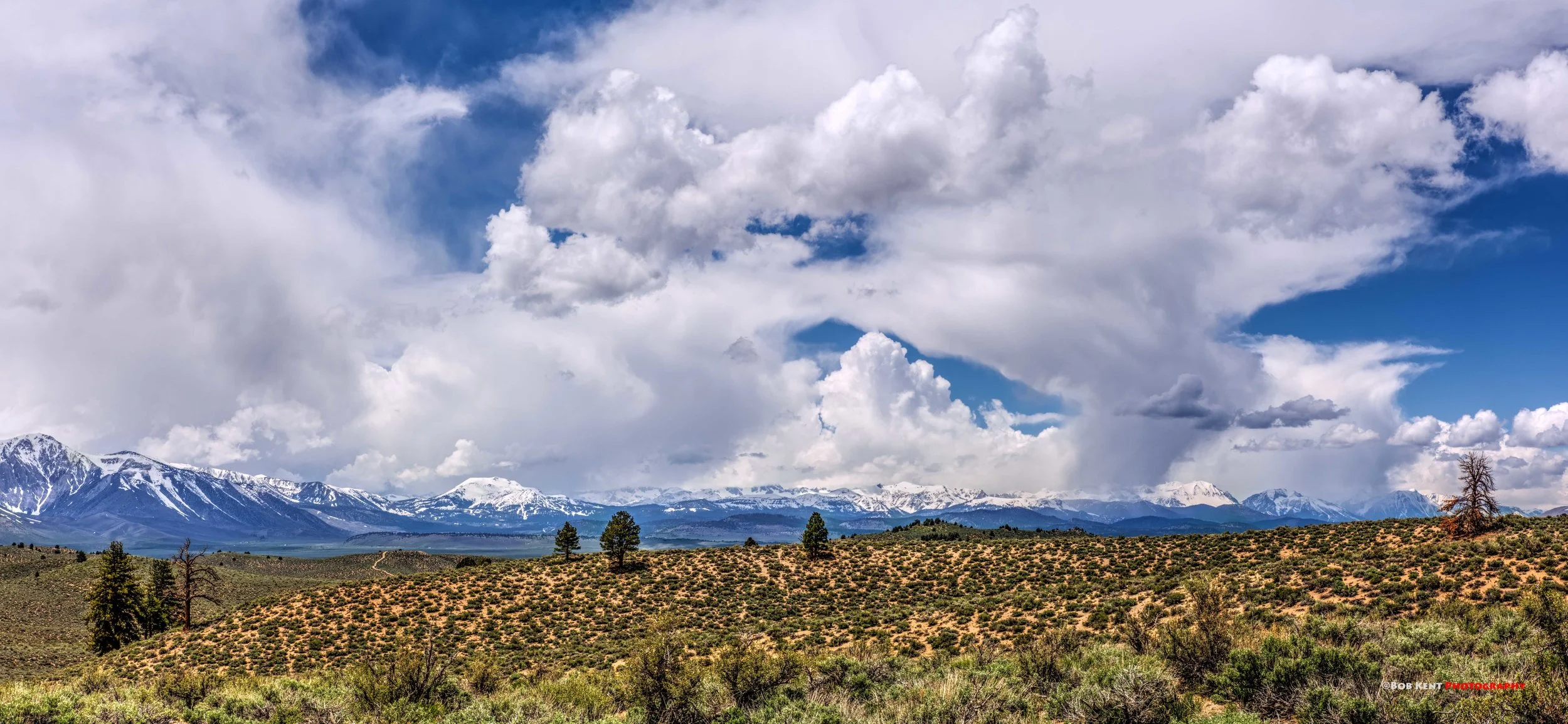
Storms over the Eastern Sierra. Lots of snow still on Mammoth!

Symmetry in Nature

and on and on and on! Truly Heaven on Earth!
FYI, as I mentioned above I will be teaching a Photography Composition class at the Mono Arts Gallery on September 28th. Then on the 29th will facilitate a field trip to put what you learn into practice. You can sign up here. Would love to see you there!
Feel free to comment and share!
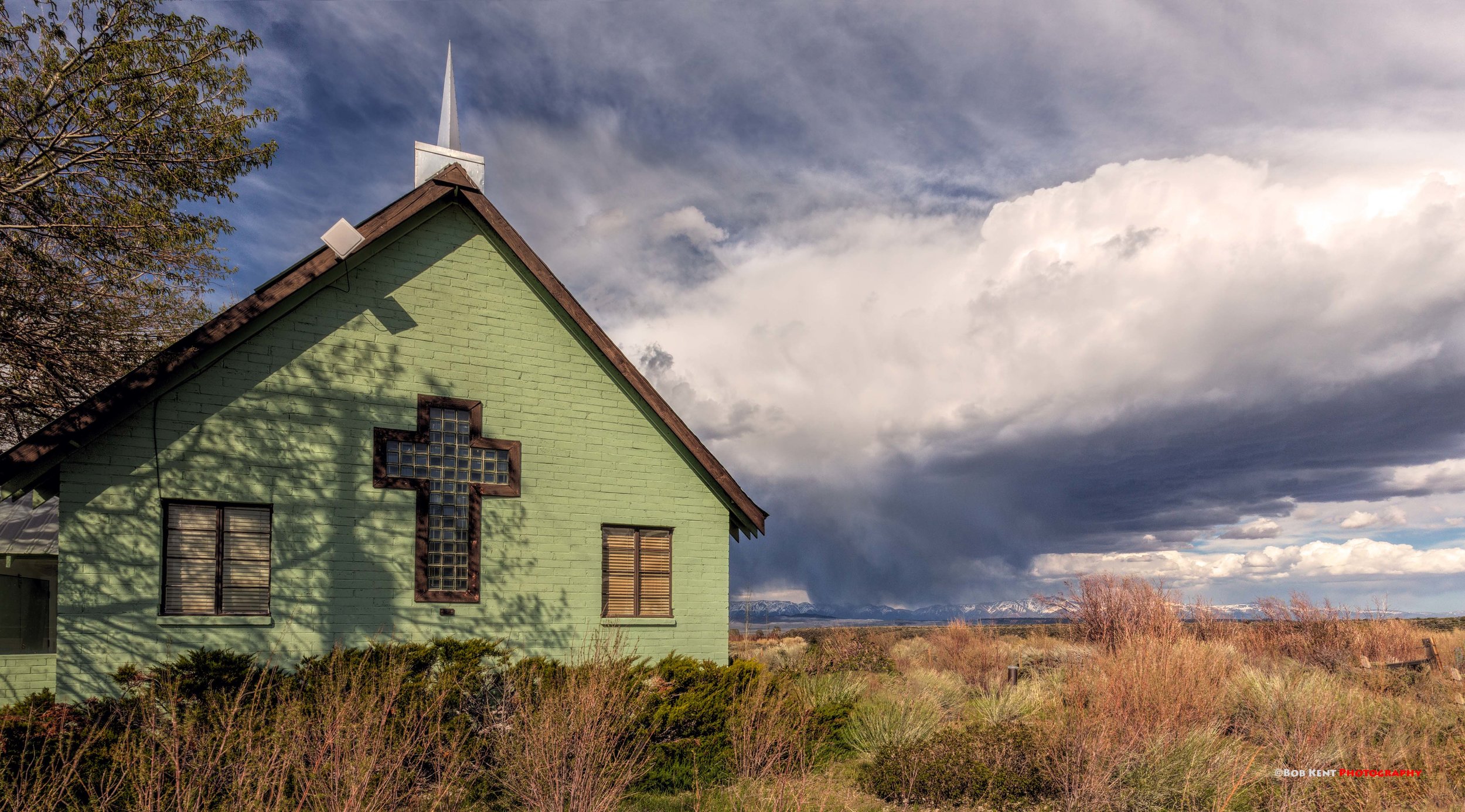
A Perfectly Cloudy Day
Me and my camera took off for the high country. When we got there, it was cloudy. Perfectly cloudy to be exact. You see lots of people love blue skies, but photographers think blue skies are boring and long for partly cloudy skies. Especially Cumulus, Cumulonimbus, Stratocumulus, and Lenticular clouds. The first three are what the Lord gave me this “I got to go” trip.
We live in LA, wait we live in Mammoth. Yes, we are one of those folks, but our Mammoth place doesn’t stay vacant much. We are not skiers, so we take a winter hiatus during the snowiest part of winter and let the ski people enjoy our place. The winter withdrawal this year was worse than usual. Work has been intense, and I needed a John Muir soul “refresh.” I told my better half “we have to go now.” She said she had to work but was an angel for letting me go without her.

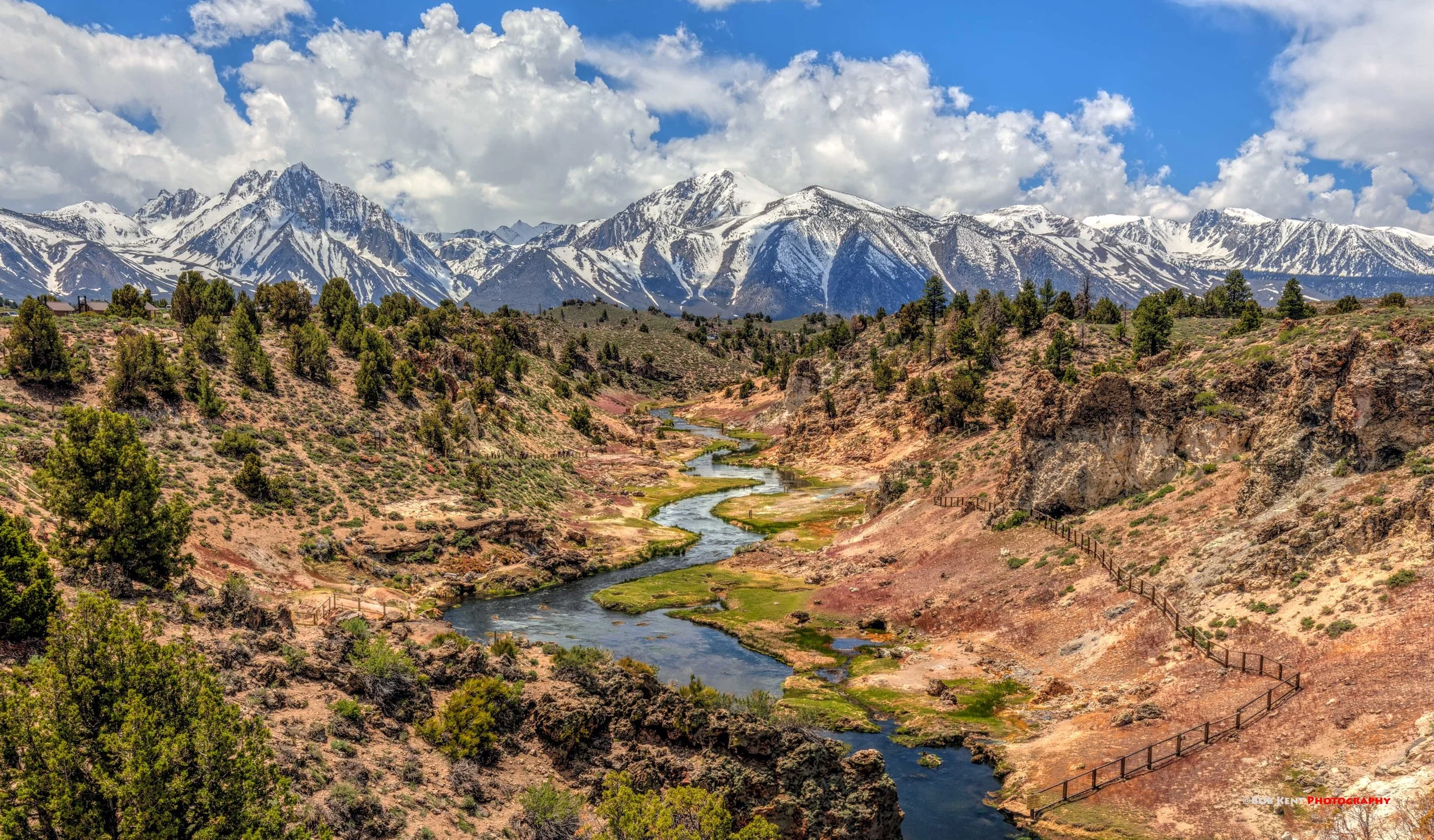
The entrance to Hot Creek Never looked so good!
Me and my camera took off for the high country. When we got there, it was cloudy. Perfectly cloudy to be exact. You see, lots of people love blue skies, but to photographers blue skies are boring. We long for partly cloudy skies to add impact to our images. Especially Cumulus, Cumulonimbus, Stratocumulus, and Lenticular clouds. The first three cloud types are what the Lord gave me this trip. It was like he was saying good decision to come on this trip!

Green Church with Clouds! FYI, this is the first time I captured an image of the Green Church I liked!
As a teenager and when my kids were young I remember afternoon thunder clouds while camping at Silver and Twin Lakes. This trip was like a Deja vu. There were afternoon clouds and thunderheads all around. Over the whites, over the Eastern Sierra, seemed like they were everywhere. I needed something to frame the clouds. Off to Hot Creek I went.
This one huge cloud kept morphing as the afternoon went on. I followed it for an hour or so. After I had chased the clouds for hours and thought I had gotten my fill, I headed off to Tom’s Place to get a JoJo margarita. She makes a mighty fine margarita. On the way I kept having to stop because I would see another awesome thunderhead rising above a mountain ridge line here then there.
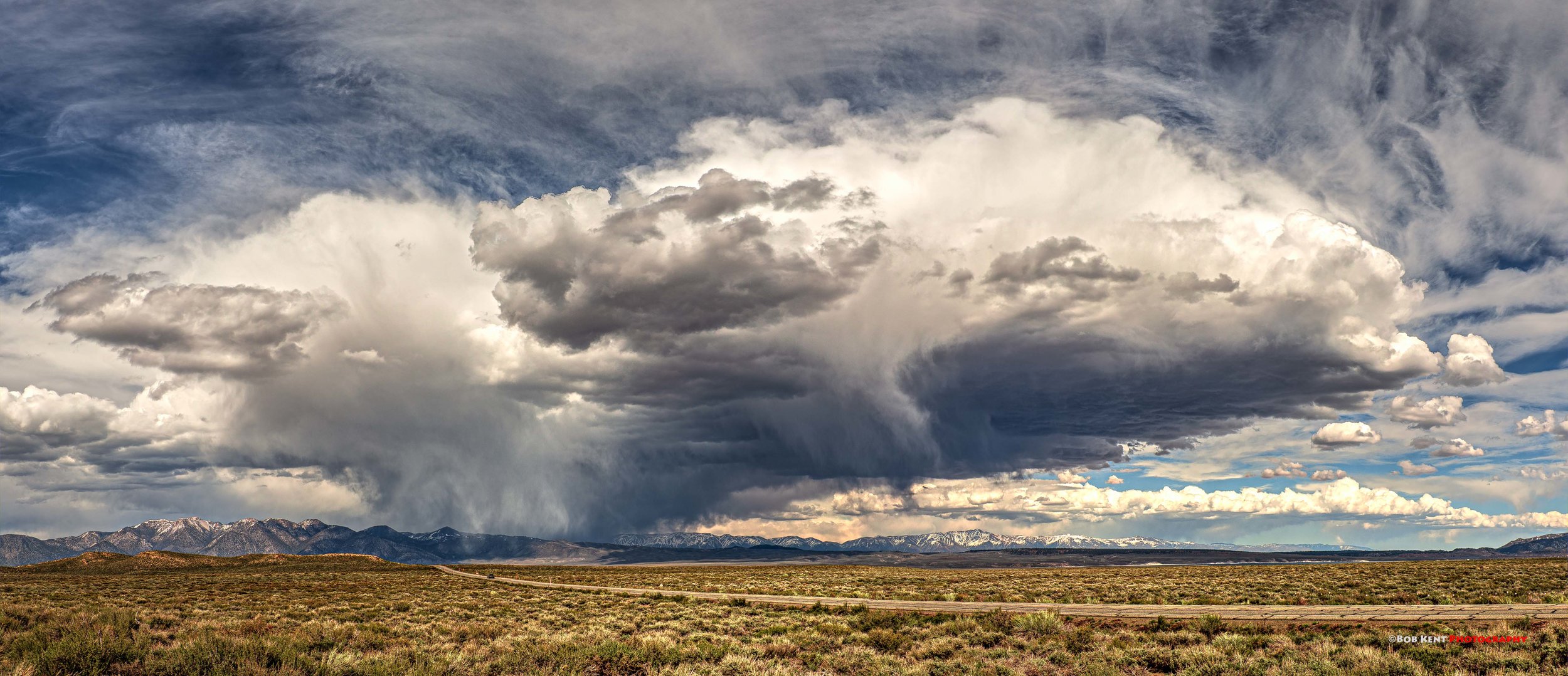
Either this is what Moses saw in the desert of aliens are coming! :-)

The afternoon was just gorgeous

Tree with a crown of Clouds
The amazing thing about the trip was with all this weather activity, the water on the lakes in the June Lake loop was so still that the lakes looked like mirrors. Since still water is another of my favorite things I got a twofer on this trip!

Silver Lake Glass (a Blog post in its self)
What a great weekend. So glad I decided to heed the “calling” of mountain’s to go!
FYI, I will be teaching a Photography Composition class at the Mono Arts Gallery on September 28th. Then on the 29th will facilitate a field trip to put what you learn into practice. You can sign up here. Would love to see you there!
March in Like a Lion ( and leave the same way!)
For me this was a March for the history books! For me March has been a Lion all the way through. I cannot remember a March in which I experienced such a diversity of photographic experiences.
March roars in like a lion
So fierce,
The wind so cold,
It seems to pierce.
The month rolls on
And Spring draws near,
And March goes out
Like a lamb so dear
Lori Hill
March roars in like a lion
So fierce,
The wind so cold,
It seems to pierce.
The month rolls on
And Spring draws near,
And March goes out
Like a lamb so dear
Lori Hill

March is a transition from Winter to Spring - Reservoir on the Tejon Ranch
The theories on the origins for the saying “March in like a lion and leaves like a lamb” are multiple. Some are based on folklore describing the shift from winter to spring in the northern hemisphere. March is usually the month where winter shifts from winter to spring. So it usually starts off cold and stormy and ends calmer and warmer. Usually is the key word as there is nothing totally predictable during the transition between seasons. Which makes them so wonderful.
Another theory is based on the stars in the beginning of March Leo (the Lion) on the horizon at sunset but is replaced with Aires (the Ram) on the western horizon.
The most interesting insight was a Christian interpretation. It follows the thought that Jesus came into the world as a Lamb and will return as a Lion - in weather language means having a false spring.
Anyways for me, this March has been a “Lion” all month long. Its been one for the history books! Normally, March is kind of boring. Its cold, it rains, you stay inside. This March is different, I cannot remember one in which I experienced such a diversity of photographic experiences. It started off with a wonderful hike on the Tejon Ranch.
A storm had just broken up the night before and its remnants were hanging around the mountains. The result was this beautiful sunny day blessed with wonderful clouds that kept changing the light and shadows on the ground. A friend on the hike quipped “you could stand in one spot for the day and the scene would change a thousand times.”

The light kept changing creating these beautiful scenes

Beautiful Day

Beauty as far as the eye can see!
Then during my once a week work commute between LA and San Diego, Waze directed me out to the I-15. Well, from the I-15 there is no missing , the now infamous, Walker Canyon “super-bloom.” Luckily, I stopped to enjoy it weeks before the massive crowds made it a zoo.

Walker Canyon and I-15

The Hills are alive

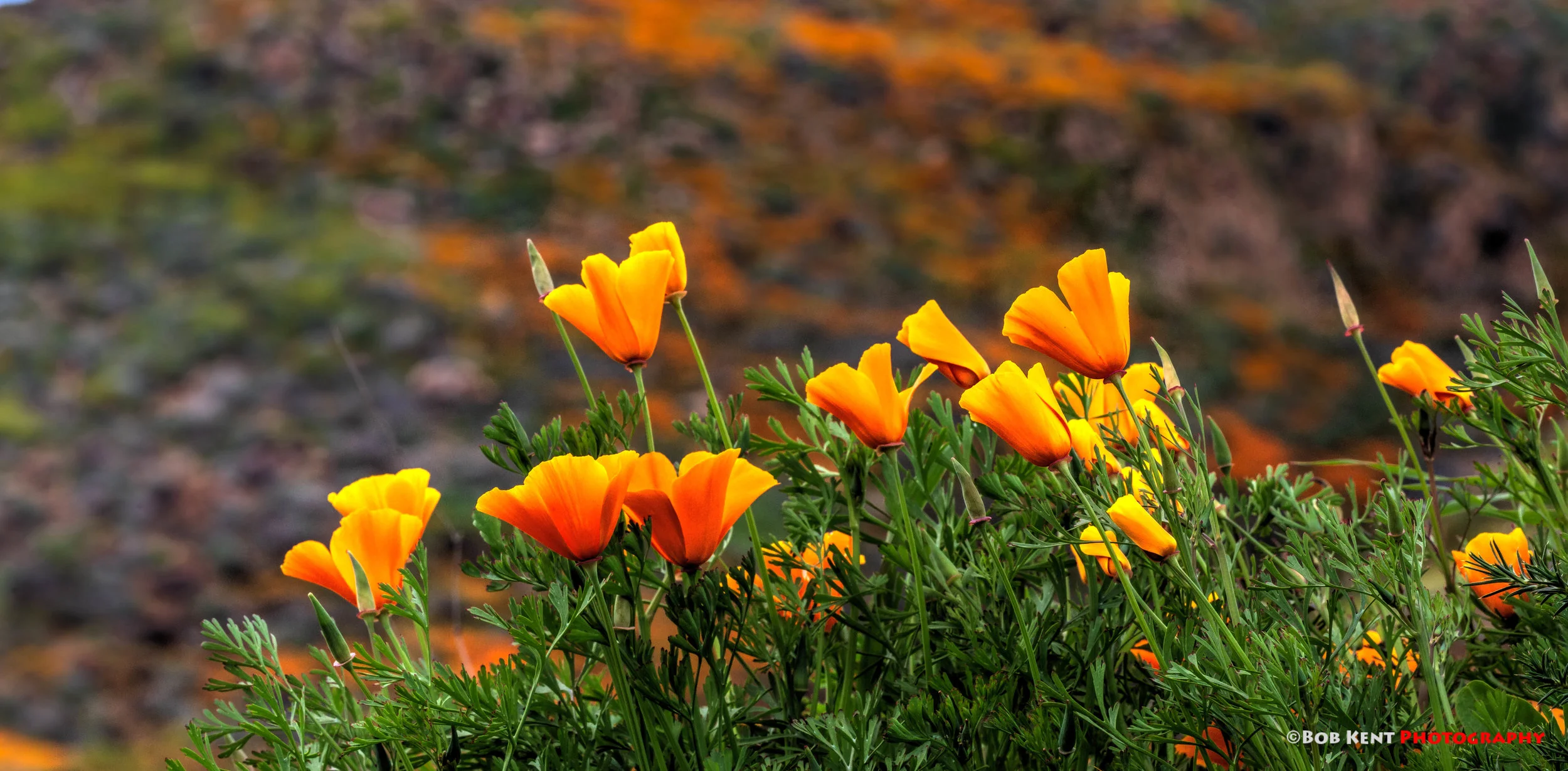
Poppies prove that if small things join together they can make a big difference
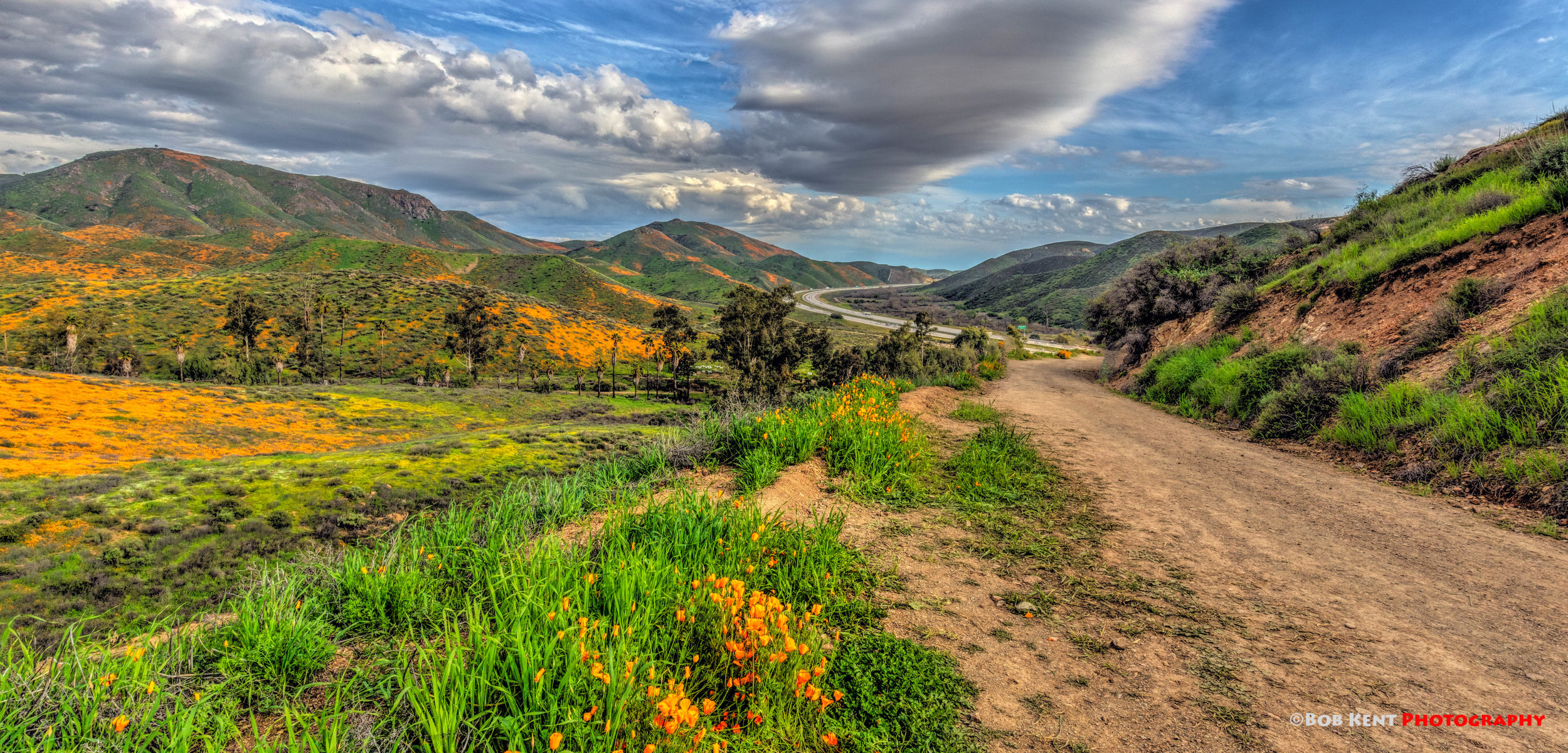
Mountains, Clouds, and Spring Flowers what more could you ask for?
Even with spring wildflowers starting to bloom the March “Lion” was not finished yet. We took a trip up to the Eastern Sierra to check out how much snow was left. Oh my. We tend to be summer/hiking folks and don’t get up to the Sierra much in the winter months. 2019 has been an exceptional snow year and based on the snow still left on the ground and the fact it is still snowing the “Lamb” part of March missed its flight and won’t get into town till April.

First Light on Snow Covered Sierra

Closed for Winter! ::-)

All Roads Lead to Snow
Finally, I took a trek out to Death Valley to see the military pilots practice low level flying in a canyon nicknamed Star Wars Canyon (or called by the Pilots “the Jedi-transition.”) Talk about coming in like a Lion! The best description I can give about this canyon, other than “Oh sh*t”, it is the only place I know that you point your camera lens down to take a picture of a jet going by at several hundred miles an hour.

You can read the names of the pilots on the side of the plane!

Reminds me of a scene at the end of the “Dragnet” movie

I would call it tree top flying except there are no trees…

Hats off to these pilots they have a lot of “huevos” and I am glad I am on their side
While March still has few days left it will be snowing in Mammoth so I am not sure we will see the spring “Lamb” until April.
With a March like I had I cannot wait to see what April brings!
If you enjoyed this please share. Comments are always appreciated.
The End of the Line (well maybe) - Keeler
On the east side of the dry Owens Lake, southeast of Lone Pine on Hwy 136, is town named Keeler. I think the best description of Keeler comes from the website Weird California:
“Keeler is practically a ghost town. Many of the buildings are falling apart, the lake it sits on is dry, the mines the town was built to support have been played out, yet still about fifty people live in the town, so a complete ghost town it is not.”
On the east side of the dry Owens Lake, southeast of Lone Pine on Hwy 136, is a town named Keeler. I think the best description of Keeler comes from the website Weird California:
“Keeler is practically a ghost town. Many of the buildings are falling apart, the lake it sits on is dry, the mines the town was built to support have been played out, yet still about fifty people live in the town, so a complete ghost town it is not.”
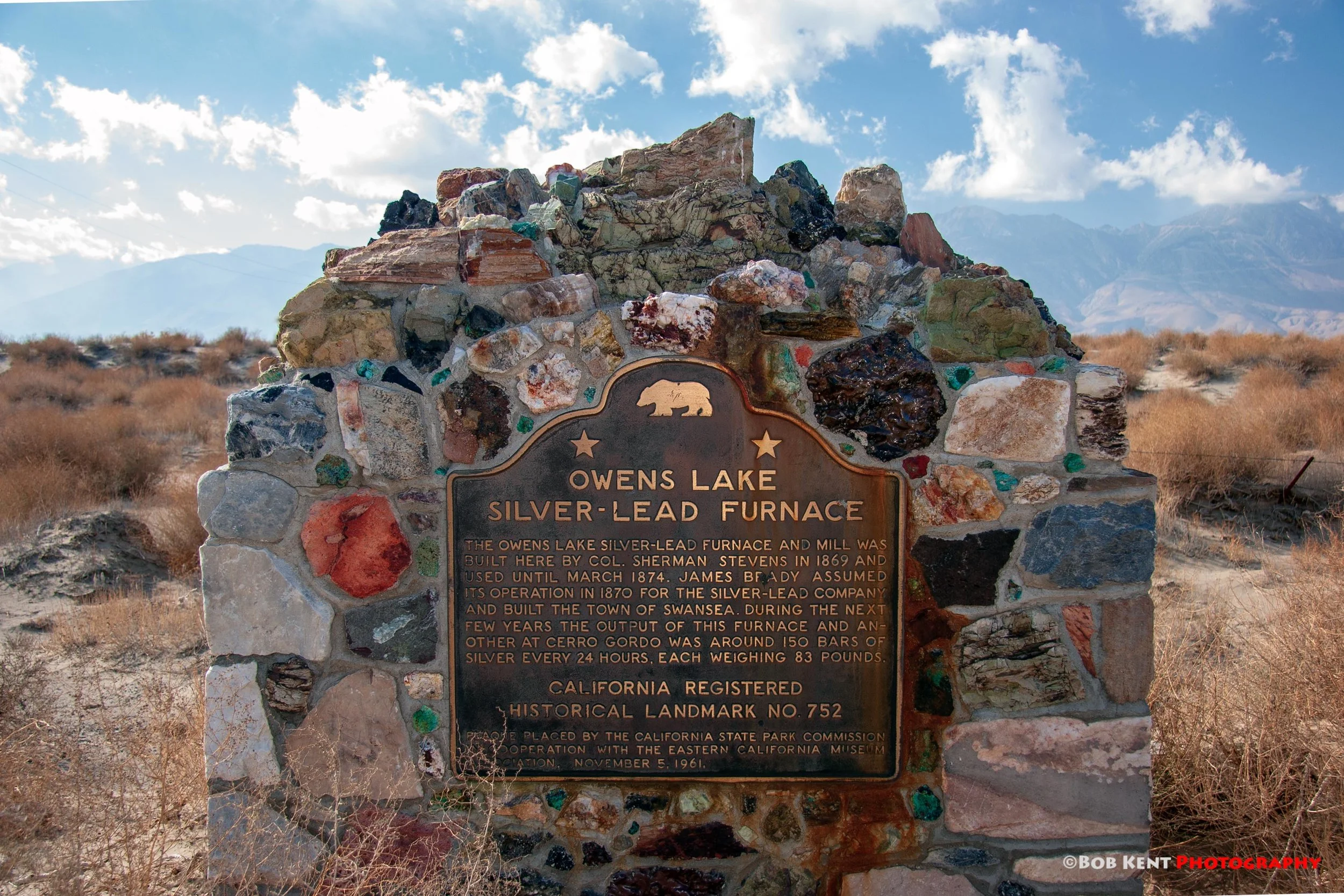
Owens Lake Silver-Lead Furnace State Registered Landmark
First things first. Thousands of years before Keeler existed there where humans living in the area. The proof is the petroglyphs in the area. The interpretation of these petroglyphs is a bit more interesting and controversial than most other petroglyph sites. Scholar Berry Fell has hypothesized that these petroglyphs were created by early European Celts thousands of years ago. That some of the markings were designed to mark the equinox(s). Many find that hard to believe. For an interesting read see the Equinox Project website.

Owens Petroglyphs
While it does not look like it now, the establishment of Hawley, Keeler’s original name, was based on capitalistic business competition. Mortimer Belshaw who was a miner and a smelter owner in Cerrro Gordo area wanted to bypass the Owens-Lake Silver-Lead Company which had a smelter and the only shipping dock in a town called Swansea. In 1873 Mortimer bought a shipping paddle wheel vessel named the Bessie Bradie. He built his own dock in Hawley (Keeler) just south of Swansea so he could bypass the the struggling Owens-Lake Silver-Lead Company. Things got even worse for the Owens-Lake Silver-Lead company when a flash flood in the summer of 1884 created a mudslide that inundated the town of Swansea.

Swansea - This was taken a few years ago today the roof is now gone. One heck a view they had though!
Hawley really wasn’t a town just a transit hub. That was until Julius Keeler showed up in 1879. In 1880 the Cerro Gordo mine was having a revival and Julius wanted to take advantage of it. He started dreaming up plans for a new ore mill and town to surround it. He made his dreams a reality and the mill opened in 1881 and the town was formed.
Good fortune seldom lasts and Julius had some bad luck in 1882. He spent a ton of money to refurbish the Bessie Bradie only to see it catch fire and burn just after the project was completed. The loss of the Bessie Bradie ended shipping ore over the Owens Lake for good.

In 1883, with the arrival of the Carson and Colorado Railroad Keeler again became a freight hub. As with almost all mines the Cerro Gordo began to peak in the late 1880 and 90’s.

No 18 Slim Princess of the Carson and Colorado Railroad
Keeler was resilient however, and was saved in the early 1900’s by renewed mining activity. In 1906 a smelter was built at Keeler to process silver ores. In 1907, zinc mining became king and created another Keeler revival. Mining operating would increase and decrease in spits and spats until the Cerro Gordo mines closed permanently in 1933.
1913 marked another important turning point for Keeler. It was the first year water was diverted from The Owens Lake to Los Angeles. Initially the shrinking lake provided an economic opportunity for Keeler. Soda processing from the dry lake helped Keeler survive after the Cerro Gordo mines closed.
Time was not on Keeler’s side however. In 1960, economic activity had slowed enough that the railroad terminal closed and the tracks were removed. Since then Keeler has slowly deconstructed into what it is today.
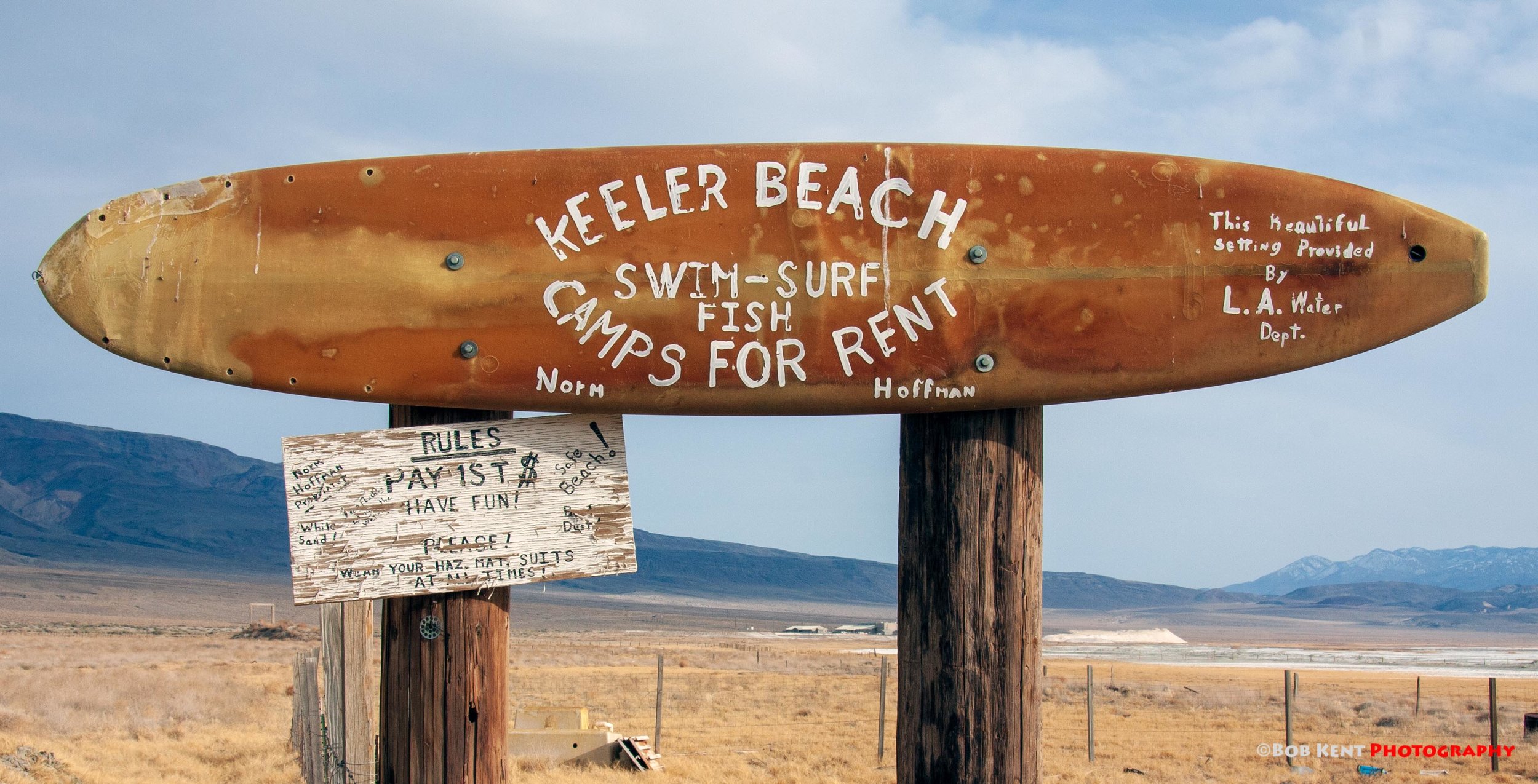
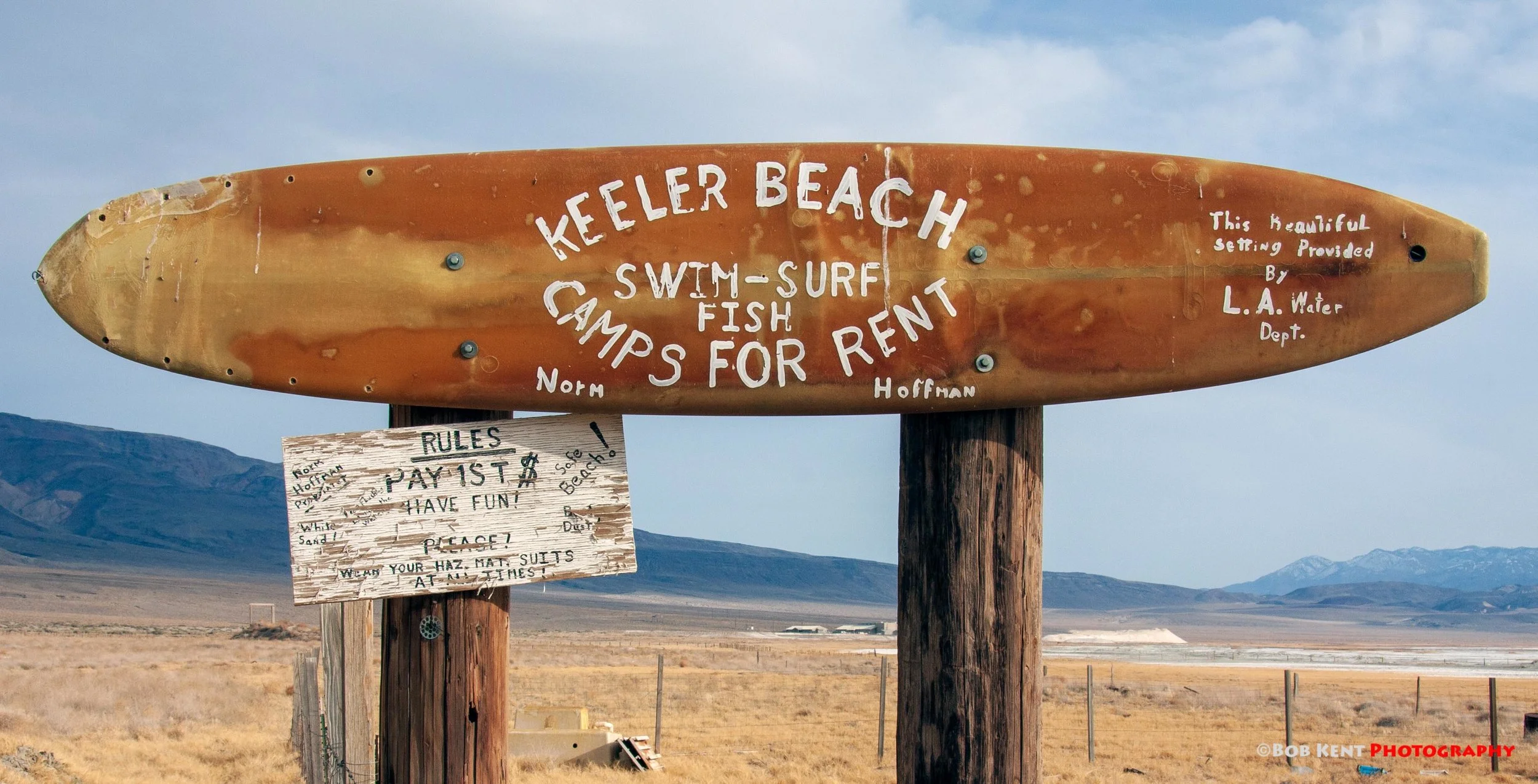
Keeler Beach
Currently around 50-60 folks live in the town. Keeler is now part ghost town, part desert outpost, and part eclectic entity. Call Keeler what you want, I call it a cool place to visit.

Eclectic Residence

Old Gas Pump
I have yet found the land marker that has the quote below but somewhere in Keeler there is this historical marker that says”
”Keeler End of the Line
From Mount House, Nevada, narrow gauge rails of the Carson & Colorado reached this site in 1883. As Cerro Gordo and other mines faltered, the rail line fell on hard times, so plans to extend the line to Mojave were abandoned, leaving Keeler as "End of the Line".
Dedicated May 12, 1973 Slim Princess Chapter E Clampus Vitus Inyo County Board of Supervisors”

Keeler Swimming Pool looking out towards the Sierra and Horseshoe Meadow Road
Keeler may be the end of the line but is worth a visit!
For some great old pictures of Keeler check out Owens Valley History - Keeler page.
If you liked this post please leave a comment and feel free to share.
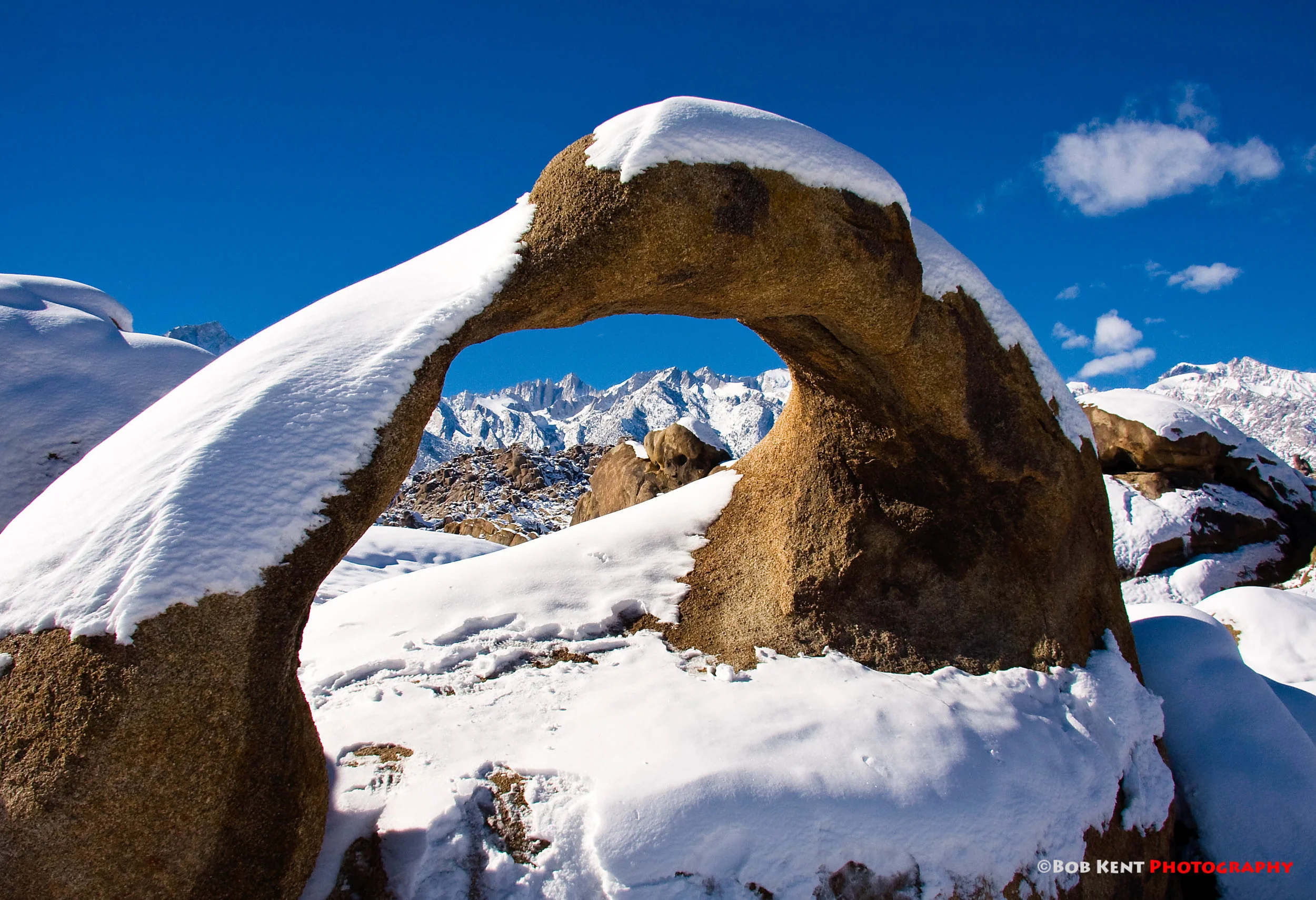
Lone Pine the Little Town Below a Big Mountain
I have been going to Mammoth since I was a teenager. Until we bought our place in Mammoth we would do a non-stop drive to Mammoth ignoring all the amazing stuff between LA and Mammoth. With a place of our own we started spending more time in the Eastern Sierra. With that regularity the need to rush straight through to Mammoth went away We started exploring cool things all along Hwy 395. It was then I fell in love with the towns in the Owens Valley. These towns seem one dimensional as you drive through but when you get to know them they have multiple layers that make them gems in their own right. Today’s post focuses on the town I know best - Lone Pine.
I have been going to Mammoth since I was a teenager. Until we bought our place in Mammoth we would do a non-stop drive to Mammoth ignoring all the amazing stuff between LA and Mammoth. With a place of our own we started spending more time in the Eastern Sierra. With that regularity the need to rush straight through to Mammoth went away We started exploring cool things all along Hwy 395. It was then I fell in love with the towns in the Owens Valley. These towns seem one dimensional as you drive through but when you get to know them they have multiple layers that make them gems in their own right. Today’s post focuses on the town I know best - Lone Pine.

Lone Pine has incredible layers both natural and man made
Let’s start with a trivia fact. The famous hills to the west of Lone Pine are called the Alabama Hills. The name for these hills were given by pro-Confederate prospectors They chose the name after the CSS Alabama, the most successful Confederate war ship in the war. The CSS Alabama captured 65 ships, flying the American Flag, and sunk one Union warship. The pro-Union prospectors were not to be out done. They named the pass above the Alabama Hills the Kearsarge pass after the USS Kearsarge which was the ship that sunk the Alabama. Pretty funny when you think about it.

Lone Pine and it’s Alabama Hills are famous for its relationship with the movie industry. Over 300 films have been filmed here over the years including the 1938 classic Gunga Din, countless westerns and famous movies like Spencer Tracey’s Bad Day at Black Rock and Humphrey Bogart’s High Sierra.
You can check out this rich history at the Lone Pine Film Museum.
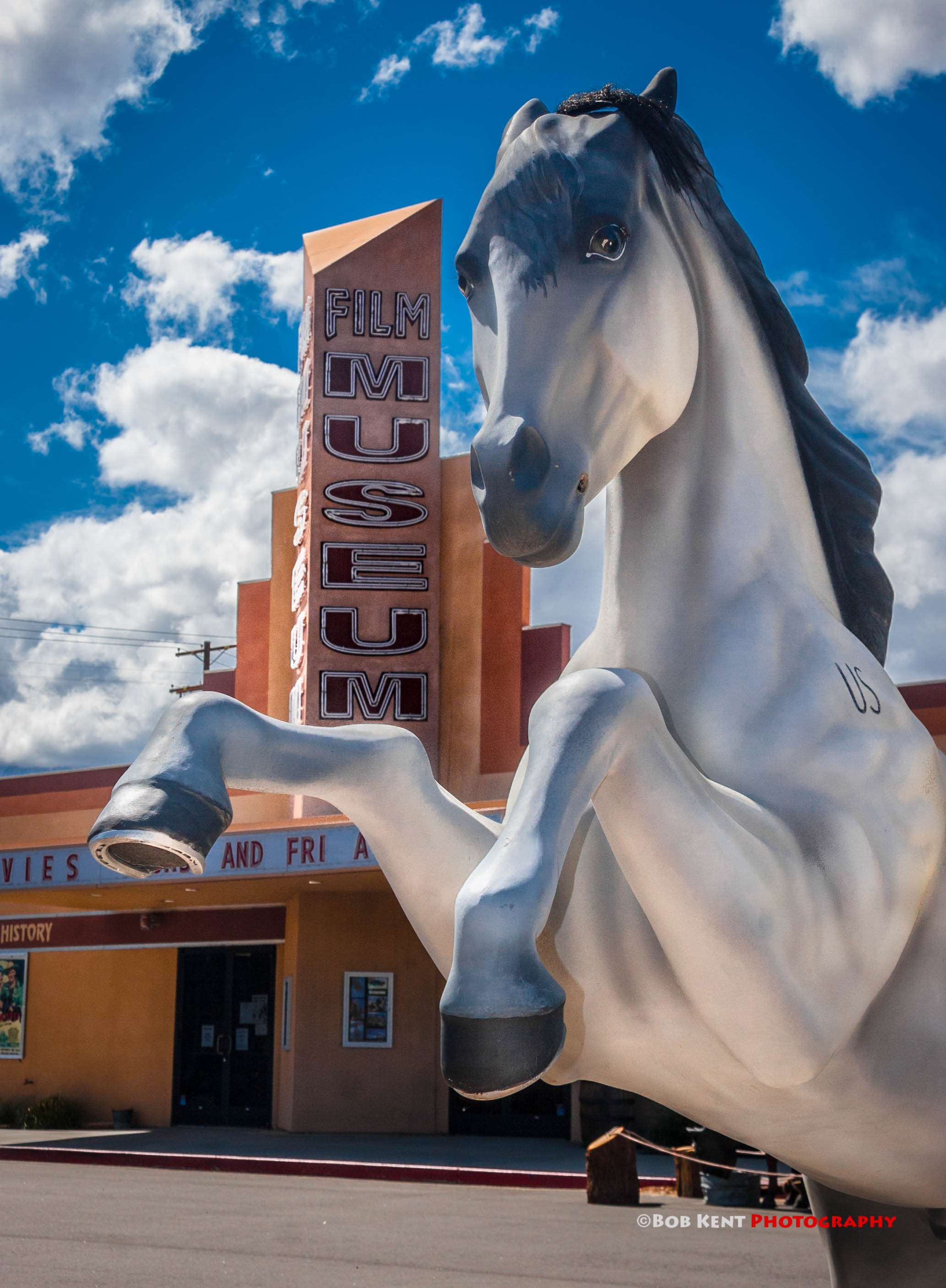
If you go be sure to watch the film it is pretty cool.

The Alabama Hills are also famous for there unique rock formations that are both beautiful to view but also spark your imagination. Explore enough and you will start to see figures in their shapes.

The Mobius Arch is one of the most famous arches in the Alabama Hills
But it is not the only one.

After a while you start to see images in the formations.

Jabba the Hut

Octopus maybe. If you look close you might find a laughing pig.
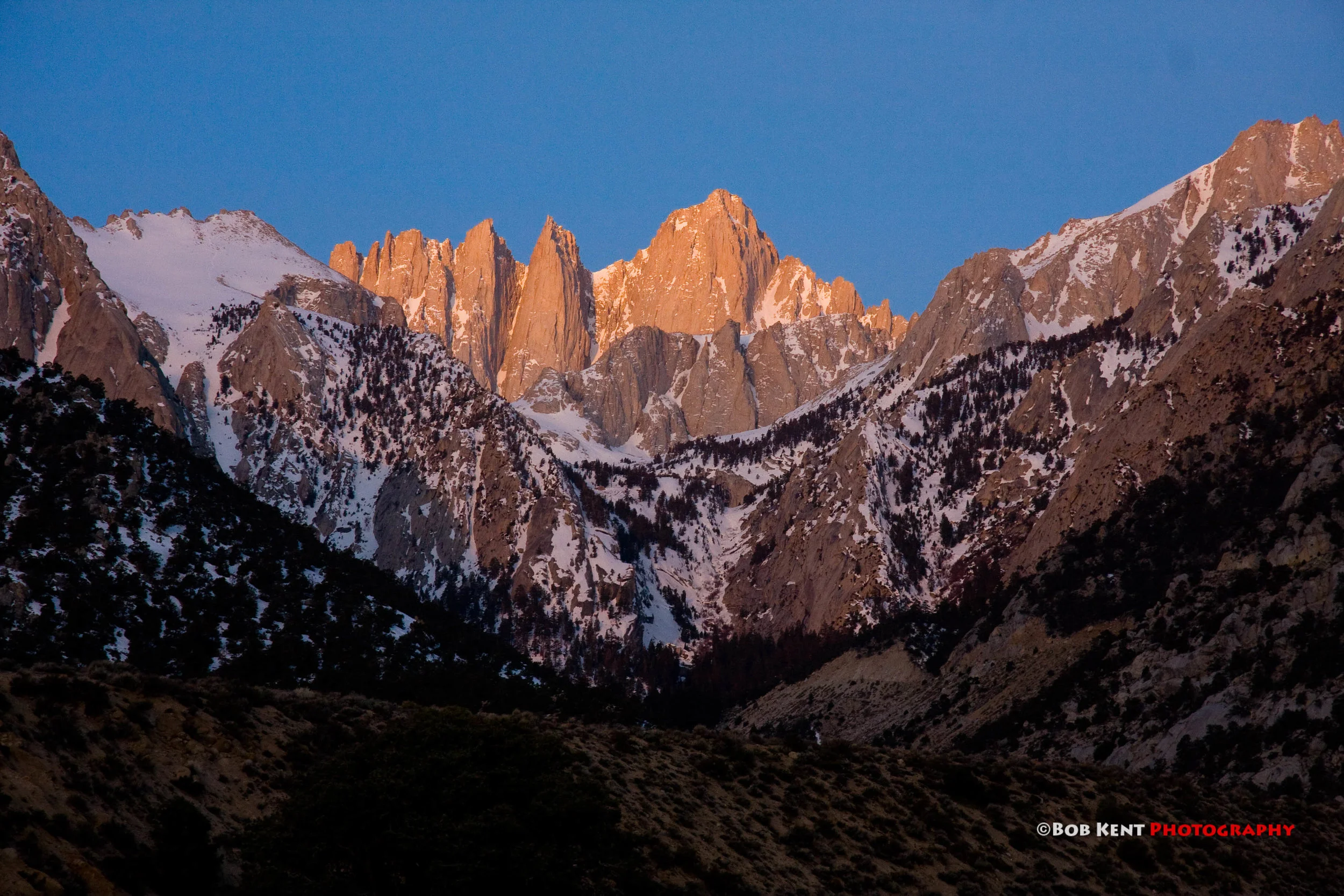
Towering above Lone Pine is Mt Whitney. With a height of 14,505 feet it is the tallest mountain in the contiguous United States.
About 9,000 feet up is Whitney Portal. There are camp grounds there and it is the trail head for the hike to the top of Mt Whitney. The portal is a wonderful stop on its own, It has a small pond with trout in it. Many like to fish others just like to sit and relax.

Fishing Pond at Whitney Portal
There is also a gorgeous waterfall as well.

If you don’t want to hike all the way to the top of Mt Whitney a much shorter but rewarding hike is to Lone Pine lake.
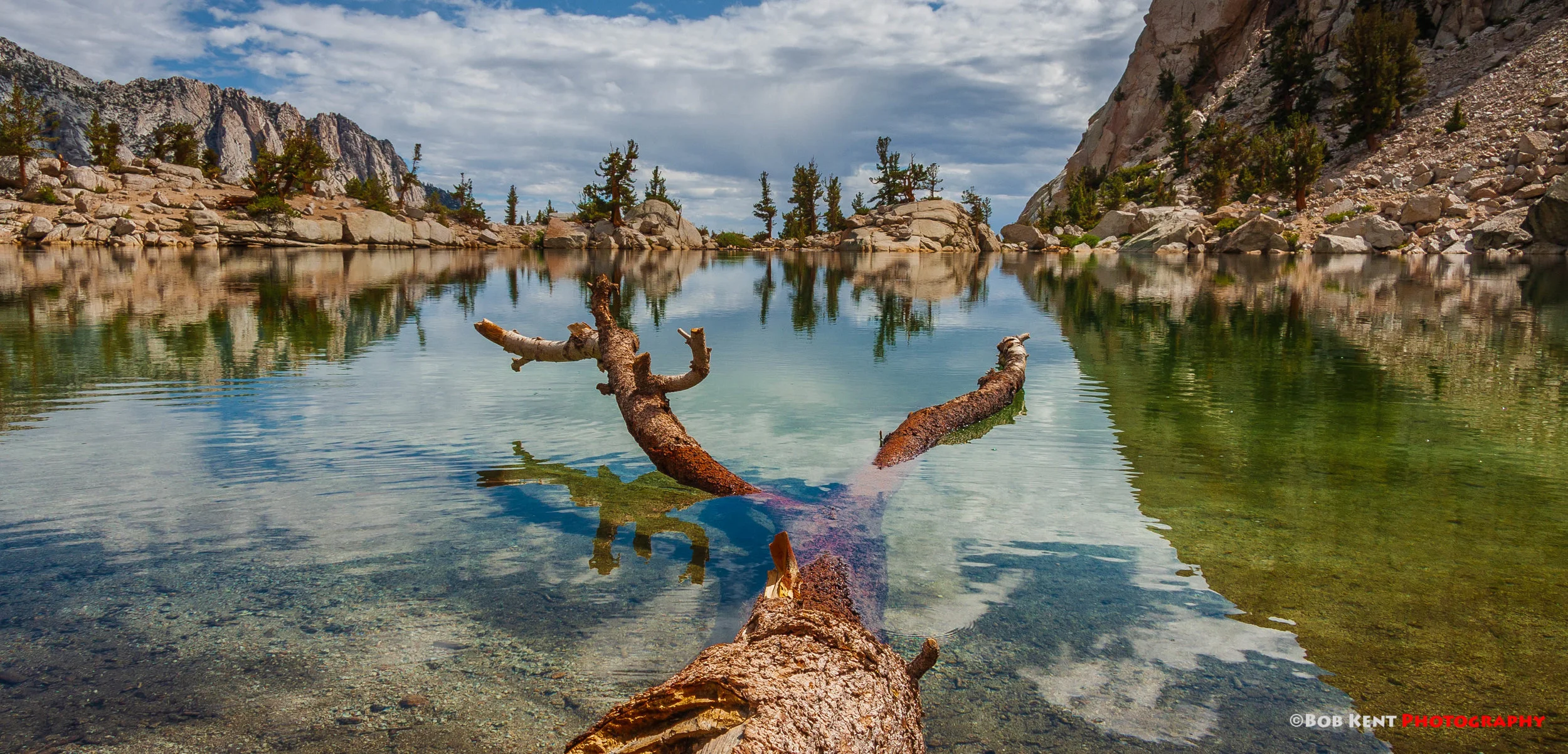
Lone Pine Lake sometimes looks like a scene from Jason and the Argonauts
If all this physical activity makes you hungry then the Whitney Portal Store has you covered with their huge pancakes!

Two plates are required to hold these pancakes.
If you want to wait to get back to town to eat there are some awesome restaurants it town. A few of our favorites are:
The Alabama Hills Cafe - Breakfast and Lunch

Alabama Hills Cafe
Seasons - Dinner is a great sit down restaurant.
Lone Star Bistro - Great sandwiches, hot dogs and ice cream
Frosty Chalet - for a quick bite to eat.

There is a nice grass area and shaded patio to enjoy your food at the Frosty Chalet
If you want just to sit down have a beer and possibly meet folks from around the world Jakes is a great little old saloon-. We have met folks from France, England, Australia, and more while we were there.

Bud sign at Jakes
Just north of Lone Pine is Manzanar one of the WWII Japanese Interment camps. It is now a National Historic Site where you can see both the hardships endured and the courage that our Japanese citizens displayed.

A barracks at Manzanar
I hope you see there is much more to do in Lone Pine than grab a burger and gas. Next time you are heading up 395 plan to spend time in Lone Pine!

Mt Whitney and the Alabama Hills always look good in snow!
The Wildflowers are Coming, the Wildflowers are Coming; are You Prepared?
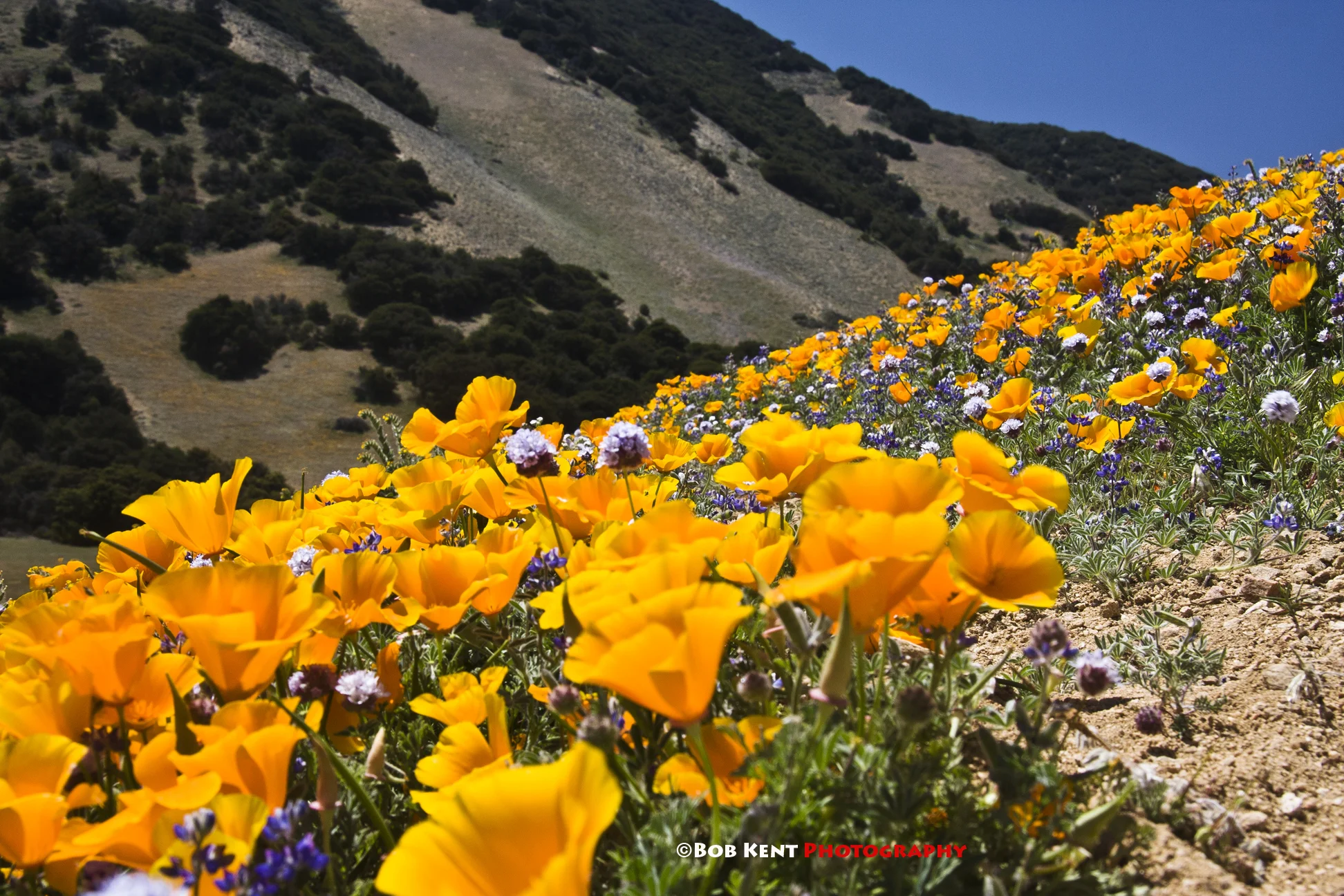
It’s February and raining and snowing a lot. The skiers in the Eastern Sierra are in heaven, but what are the non-skiers to do with our time? Prepare for the wildflower season of course. The flowers are already popping up here and there already. I wanted to provide a list resources to help you plan your wildflower hunting season. We will cover:
Where to look for wildflowers and websites that track the wildflower blooms
How to know what you are looking at. Yes, there is an app for that and I found a great website.
Tips on how to take great wildflower pictures
It’s February and raining and snowing a lot. The skiers in the Eastern Sierra are in heaven, but what are the non-skiers to do with our time? Prepare for the wildflower season of course. The flowers are already popping up here and there already. I wanted to provide a list resources to help you plan your wildflower hunting season. We will cover:
Where to look for wildflowers and websites that track the wildflower blooms
How to know what you are looking at. Yes, there is an app for that and I found a great website.
Tips on how to take great wildflower pictures
Forgive the length of the post but it gives you a lot of info.

Locations
Tripsavvy has a great list. I suggest you check the website out because they also have resources by site. Here is an overview of their list and excerpts of their descriptions:
Anza-Borrego Desert: January through March - located south of Palm Springs, Anza-Borrego State Park often puts on the best desert wildflower show in California.
Death Valley: February-April - when they show up, Death Valley's wildflower displays are eye-popping because they occur in a landscape so devoid of color the rest of the year.
North Table Mountain: February-April - in a good year, North Table Mountain is decked out in more than 100 kinds of wildflowers.
Valley of the Oaks: March-April - west of King City that is little changed since Spanish colonial days. The land has never been cultivated, making it a great place for spring wildflowers.
Carrizo Plain: March-April - the wildflower displays that follow a rainy winter there are some of the state's best. During that time, docents lead tours to see them.
Antelope Valley: February-May - in a good year, the carpets of orange-hued California Poppies…
Hite Cove Trail: March-May - most visitors speed right past the Hite Cove Trail on their way to Yosemite, but the number of cars parked near a seemingly insignificant trailhead is a clue. In fact, the Hite Cove Trail is one of the most spectacular places in the Sierras in late spring. Some say it's the best wildflower hike in California.
Eastern Sierras: May-July - the iris blossom between late May and July, depending on elevation They start first around Bishop and bloom later near Mammoth Mountain.

Resources
Modern Hiker is a great site and it is not surprising it has a great page on wildflower resources. Here is a summary of the resources they recommend:
The Theodore Payne Foundation’s Wild Flower Hotline – this reader-submitted flower update covers most of Central and Southern California and is often a good place to start your search.
DesertUSA’s Wildflower Reports – DesertUSA kicks off their wildflower reports in January, which gives people plenty of time to start planning their trips as well as researching early predictions on which areas look like they’re experiencing the right conditions for good blooms.
What’s Blooming in the Santa Monica Mountains – This list focuses on the Santa Monica Mountains National Recreation Area. Here, the reports are divided into different parks and even specific trails within those parks.
Park Specific Sites – Many of the better-known wildflower viewing areas have their own park-specific reports, with varying degrees of regularity and specificity.
Finding Out What You’re Looking At:
There are smartphone apps that help you identify what you are looking at. This page gives a review of several of them out there.
Desert USA has a great page that has pictures and descriptions of a ton of desert wildflowers
Photography Tips
Now that you know some good California locations and how to check how the blooms are doing. Here are some tips on how to take pictures that will wow your friends.
Fields and Flowers – There are two basic approaches to taking wildflowers.

Use objects in the foreground and background to provides a sense of scale
Fields of Dreams - One approach is to take an image of the field. With hundreds and possibly thousands of bright colored flowers make for an incredible scene. To take these scenes over the top try placing something in the foreground of the image to give the viewer a sense of scale. You can also build a layered composition. For example, you could have a tree in the foreground, wildflowers in the midsection, and a building way off in the distance.

See with the flower on the right how fast things get out of focus. On the left the camera was perfectly aligned with the plane of the flower and everything is in focus
Individual Superstar – Some of the most impactful images are of individual flowers. First, pick a good flower that has not been beaten up. Second pay attention to the background. If you have an adjustable camera use an aperture setting to blur the background. Your viewer’s eye will immediately concentrate on the part of the flower that is in focus. Plan out what you want in focus. The front, center, or all the flower. If you want all the flower in focus, make sure your camera is in parallel with the main plane of the flower.
Shutter Speed – Wildflowers are delicate, any amount of wind will begin to blow them around. If you have an adjustable camera set your shutter speed to 200 or 400. It is better to increase your ISO and get a slightly grainy but sharp image than one with no noise that is blurry.
Weather – It may be counter-intuitive, but an overcast day is probably better than a sunny day. Sunny days create harsh shadows and blown out color.
Best Time of Day to Shoot – Early morning when the sunlight is low and there is no wind. One thing to know some flowers don’t open until they get sunlight.
Equipment
Tripod – the flower is moving which means your camera shouldn’t be.
Telephoto Lens - the longer focal length will help you isolate a wildflower in front of a blurred background. It's important that your telephoto lens has a very short minimum focusing distance (at most 5 feet), so you can get close enough to flowers to fill the frame.

Use a telephoto to blur the back ground and put the focus on the flower
Remote Shutter Release – again the flowers are moving so your camera should not be moving. Pushing the shutter release on the camera tends to move the camera. Don’t have one, don’t worry. Just set your camera’s delay timer to 2 or 10 seconds.
DSLR or Mirrorless Camera – Don’t mean to sound snooty but these types of cameras have more options, shutter, aperture, ISO, etc. that gives you more control making the image you want. Don’t have this type of camera don’t worry go anyways. It’s better to go and take pictures, with whatever you’ve got, than not going at all.
Happy hunting!
My 12 Best Images of 2018
The 12 Best of 2018
Why 12? To be different. Everyone else has a Top 10. Besides I like the idea of one for each month. Even though I did not take as many images last year, it was an awesome year for my photography. Mainly for two reasons.
During most of my trips up to the Eastern Sierra there were luscious clouds in the sky. Nothing improves a landscape photo like clouds.
I started concentrating on the improving the composition of my images. Specifically working on improving the foreground area. To me, it made a huge difference.
So here we go.
The 12 Best of 2018
Why 12? To be different. Everyone else has a Top 10. Besides I like the idea of one for each month. Even though I did not take as many images last year, it was an awesome year for my photography. Mainly for two reasons.
During most of my trips up to the Eastern Sierra there were luscious clouds in the sky. Nothing improves a landscape photo like clouds.
I started concentrating on the improving the composition of my images. Specifically working on improving the foreground area. To me, it made a huge difference.
So here we go.
# 12 Independence God Rays
The most unexpected spots sometimes consistently provide the most awesome images. In this case there is a pocket park located on the south side of Independence. It is a nice spot to stretch the legs and take a health break. On multiple times I have captured incredible images like this with awesome light and clouds. Right from within 15 feet of the street next to the park. Notice how the foreground creates an alter for the God rays.

# 11 Hot Creek Sunset
The area behind the Hot Creek gorge is one of my favorite places to watch a sunrise or sunset. The area around a certain white bridge is well magical during a sunrise or sunset. Add awesome clouds high enough to catch the suns last rays and change colors, well see for yourself. Think a couple of chairs, a bottle of wine, and some good company.

# 10 Clouds Over the Owens Valley
Remember the first reason I said my 2018 images were awesome? Yes clouds. I have always loved the cumulus clouds that have a flat bottom. Bit of trivia as here is the explanation of why they have flat bottoms. The flat bottoms of cumulus clouds define the exact height at which a critical combination of temperature and air pressure causes water vapor within the rising current to condense into a visible cloud.

# 9 Minaret Sunset
Sometime bad things produce beautiful scenes. Forest fires are natural but with the drought and other factors the fires of late have been terrible. Their smoke at sunset though creates some of the most beautiful sunsets you will see. This is the case with this sunset over the Minarets and the smoke from the Lions fire. The Minaret vista has a wonderful view but trying to capture it as a still image is difficult. In some places there are tall trees that obstruct the main image. In others there is nothing and the impact of the image gets lost in a mass of complexity. Even though I only had a few minutes to capture the scene I walked around and found the foreground to anchor the image. I think it paid off. Do you?

# 8 June Lake with Moon
June Lake is gorgeous. For years I have tried to get an image of June Lake that captured the feelings I get when I view the lake. I have always come up empty and this year I focused on getting an image that I liked. I got several, but I think this one shows the lake off at its best. Morning alpenglow, still water, clouds, and the moon.

# 7 Heart Lake Viewpoint
The Heart Lake trail out of Coldwater campground, was a hike I did not take for years because I thought it was too short and did not have any special scenery. Was I ever wrong as it had some spectacular view, wildflower, and if you walked past the lake just a bit this scene?! This scene has three of Mammoth’s most widely recognizable locations in one view: Mammoth Mountain, Lake Mary, and Mammoth Crest. Another example of using the foreground to make the image more interesting.

# 6 Heart Lake
Heart Lake is a small lake with only a hint of any interesting geology formations visible Just a simple little alpine lake. Sometimes simpler is better.

# 5 Grant Lake with White Line
Three things led to this capture.
One, the willingness just to wander. We had done the June Lake Loop earlier from the other direction but coming home with the clouds and sunset we decided to do it again.
Two, preparedness - five minutes before the clouds were ten times more colorful, five minutes after the light was gone. Like Goldilocks’ porridge this was just right. I usually travel with the camera ready to go and already on the tripod. Being ready allowed me to capture the image.
Three, listen to your photographer’s assistant. My wife has developed a keen eye for scenes worth stopping for. I was in a keep driving mode and she told me to stop and take the image. She was right, this image got more comments on Facebook than almost all my other posts.

# 4 Parker Lake with Logs
I do most of my shooting very early in the morning or around sunset. The hike to Parke Lake is one of my favorite hikes; one I have done many times. When I went with some others on a mid-morning hike, I did not plan on doing much shooting. I was stunned when we reached the lake, the water was still fairly calm and the light was not too harsh. I took my time to find the foreground to anchor the image and came away with one of my favorite images of my favorite lake. Shows that you should never assume and approach the creation of your art with an open mind.

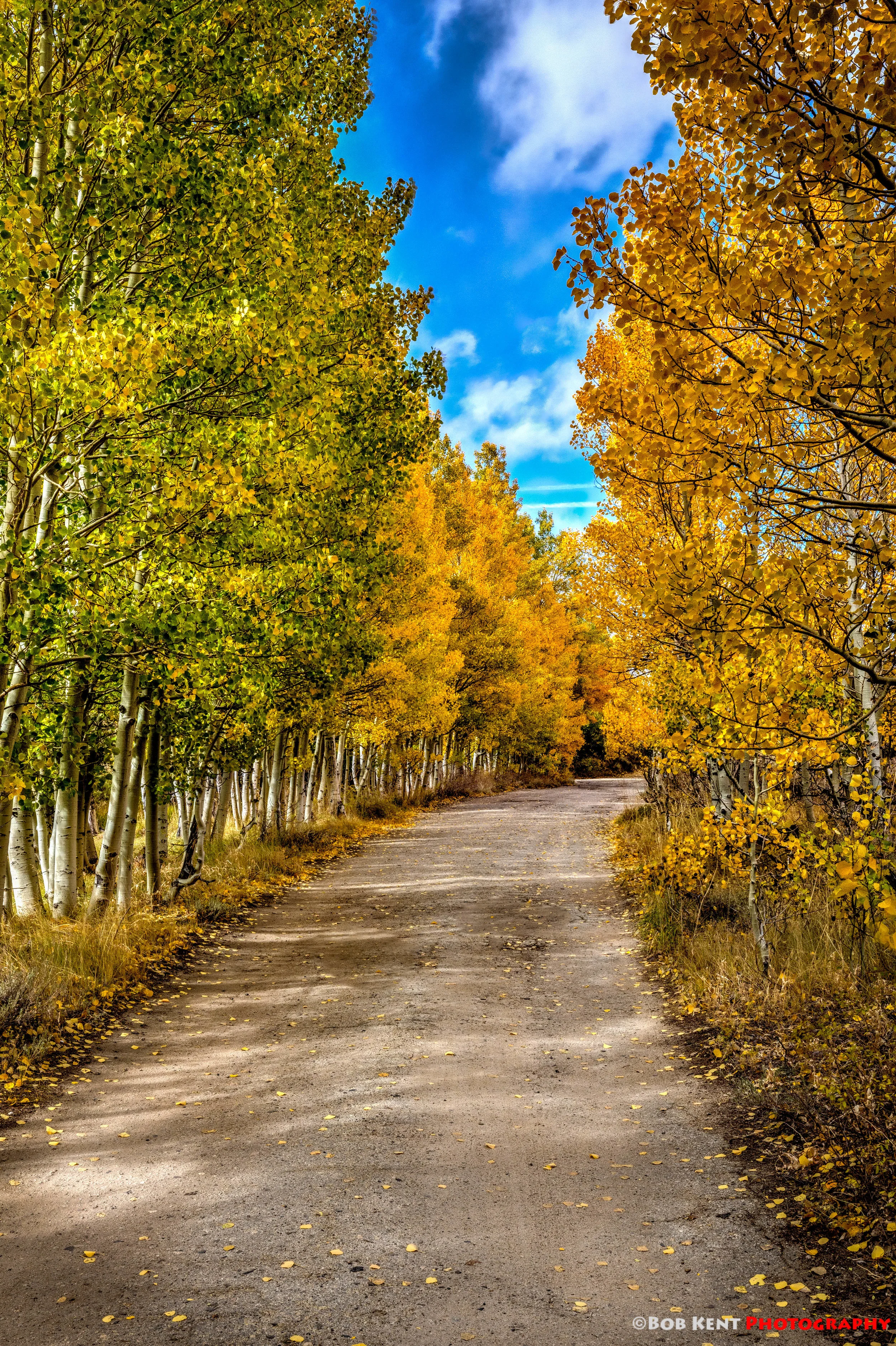
# 3 Sage Hen Road with Trees
We were taking some friends on a day tour of the cool things around Mammoth in the fall. Even though this location had passed its fall color peak, I thought the views were worth going there. Well sometimes it all just works; the light coming through the leaves, the blue sky with clouds, and a nice leading line.

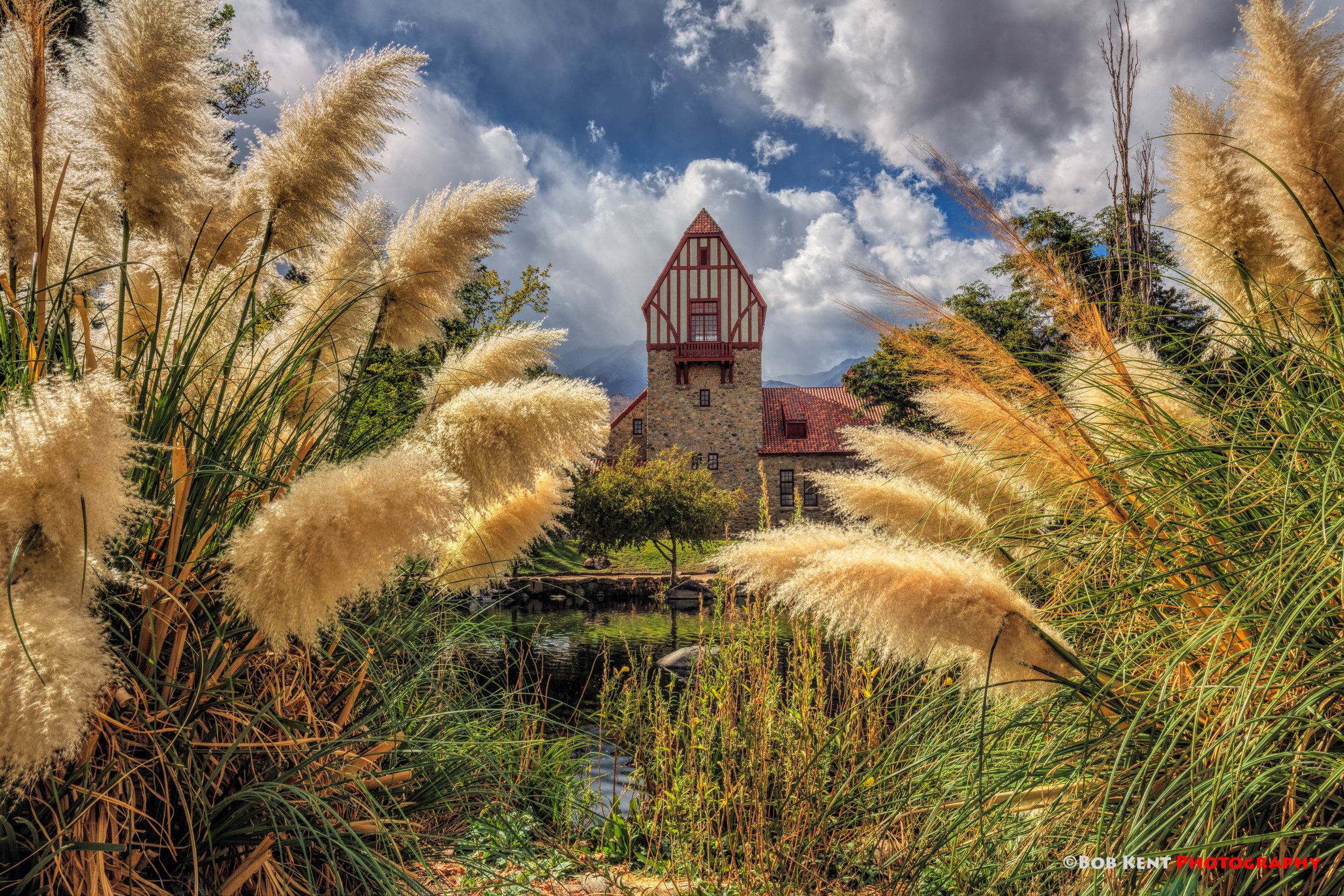
# 2 Whitney Fish Hatchery
The Whitney Fish Hatchery is a wonderful oasis in the Owens Valley. The building is picture card perfect but one I had never captured to my liking. This day all the elements of a great image were working overtime; the clouds, the light, just everything. While my photographer’s assistant was setting up our picnic, I walked around to see if I could find a new perspective. Did I hit the jackpot! This was the FB post and calendar page that got the most comments. I think you can see why.
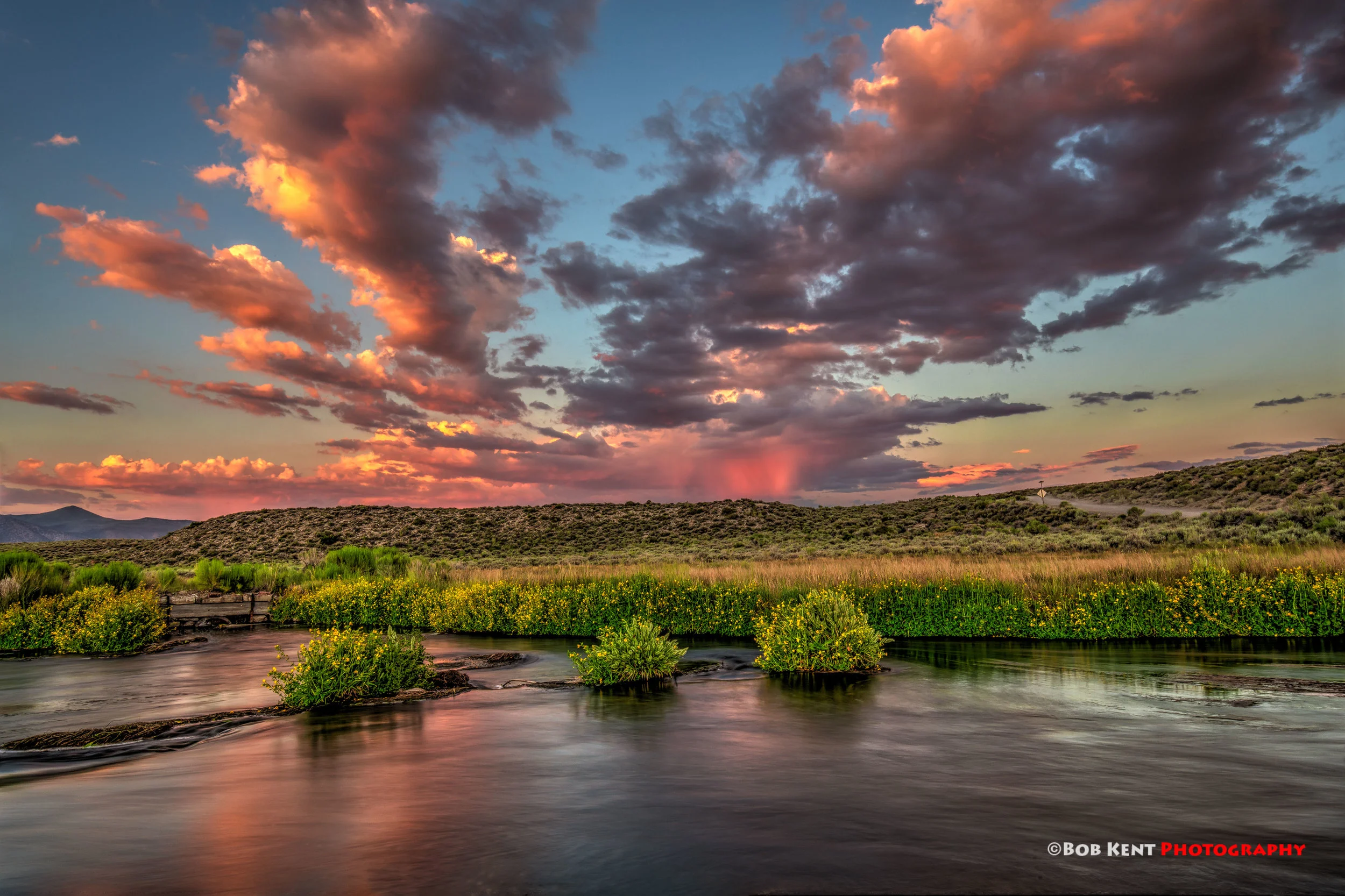
# 1 Cloudy Silver Lake
I knew as soon as I took this picture it would be the best image I captured on this trip and probably of the whole year. It is a rare gift to get still water and storm clouds. It is even a rare gift to get them late in the day. This image is taken from one of our favorite places to sit and have a picnic. We just sit and soak up the beauty around us. Occasionally, we will have deer and ducks join us to make it even more special. it was tough to choose between Whitney Fish Hatchery and this image as the best. Our personal connection to this spot was the tie breaker.

The above is my ranking, which of these images was your favorite? The bar is set high for 2019 but it will be fun to beat this list. Just pray for a cloudy 2018!
Dad Why Do the Trees Change Colors?
Every year I reluctantly hang on to summer and resist the coming of Fall. Despite my best efforts the days keep getting noticeably shorter, the nights have a chill, and heck it is mid-September and just snowed in the Sierra! So, I will throw in the towel and look forward to Halloween and Fall colors. Hopefully, this post will give you a bit of trivia and a lot of information on how to successfully see Fall colors in the Sierra.
Bishop Canyon
- March 2026
- October 2024
- May 2023
- December 2022
- July 2022
- June 2022
- May 2022
- January 2022
- December 2021
- November 2021
- October 2021
- July 2021
- June 2021
- May 2021
- January 2020
- July 2019
- June 2019
- May 2019
- April 2019
- March 2019
- February 2019
- January 2019
- September 2017
- August 2017
- July 2017
- June 2017
- January 2017
- December 2016
- November 2016
- October 2016
- September 2016
- January 2016
- November 2015
- July 2015
- May 2015
Every year I reluctantly hang on to summer and desperately resist the coming of Fall. Despite my best efforts the days keep getting shorter, the nights have a chill, and heck it is mid-September and it just snowed in the Sierra! So, I will throw in the towel and look forward to Halloween and Fall Colors. Hopefully, this post will give you a bit of trivia to impress your friends and a lot of information on how to successfully see the Fall colors in the Sierra.
Bishop Canyon
Why do leaves change color?
The short answer is simply the leaves get less light. There is more to it than that! Here is your trivia facts that you can use to impress your fellow Fall Color lovers.
Trivia Fact 1. In fall the days grow shorter. The reduction in the total amount of light the tree leaves receive induces a chemical change causing a corky wall to form between the twig stem and the main portion of the leaf.
After a while this corky wall causes the leaf to drop off the tree. Before it falls however, the wall blocks the in and exit vessels which traps sugars in the leaves. With reduced light an no new food the green chlorophyll pigments die. This allows us to see the two other pigments the leaves always have had - carotene (yellow) and anthocyanin (red).
Trivia Fact 2. The reason the leaves look more vibrant after sunny days is that the sunlight continues to produce anthocyanins after the blockage occurs. During cloudy days less anthocanin is created and the leaves take on a more pastel tones.
Weir Pond
Eastern Sierra Fall Colors Locations
While the Maine, Vermont, and the Rockies are better known for their fall colors there are plenty of places in the Eastern Sierra that put on quite a show. As the California Fall Color Web Site says “Dude, autumn happens here too.” Here are a some of the locations that usually have good showings:
- Big Pine Canyon
- Bishop Creek Canyon
- Lower Rock Creek
- Rock Creek Canyon
- McGee Creek
- Convict Lake
- June Lake Loop
- Sagehen Summit (Hwy 120)
- Lee Vining Canyon
- Lundy Canyon
- Virginia Lakes
- Conway Summit
- Walker River Canyon
- Lobdell Lake
- Monitor Pass
- Hope Valley
Viewing Etiquette
During the peak viewing time, there are tons of site-seers and photographers. Lately there are a lot of Photography Tour groups as well. There is enough beauty to go around to see so folks please be respectful of your fellow viewers! I remember a time where I was at North Lake very early in the morning. The sunrise was so beautiful and peaceful. That was until a large group of tourist that had broken up into two groups decided it was okay to loudly yell things to each other across the lake, ruining the peace for all others. Think before you yell, walk in front of someone’s camera scene, or bogart a location while other photographers are waiting behind you.
McGee Creek
Incredibly Helpful Resources for Planning Your Trip
Generally, the colors start changing first at higher altitudes usually in late September and the 1st week in October is best overall for color viewing. Unfortunately, it is not that simple. The change in fall colors is a very fickle thing. It does not always start on time. One location might look gorgeous one day then after a sudden wind storm, cold freeze, or snow storm be totally decimated the next day.
Fortunately, there are a lot of kind people that actively track and publish the current conditions. Some of the best sites are:
- California Fall Color
- California Fall Color Map
- Parchers Bishop Creek great for the Bishop Creek Canyon; North Lake, South Lake, Aspendell, and Lake Sabrina.
- Mono County Fall Color
- Calphoto Yahoo Group need to join.
- Sierra Fall Colors
- Natural History Wanderings Foliage Reports
Lower Rock Creek
Best blog post and How To Book
G. Dan Mitchell provide an incredible amount of valuable info!
· Sierra Nevada Fall Color Season – Coming Sooner Than You Think!
Hope this helps you in your quest to see one of nature’s best shows. Maybe I will see you out there among the colors!