The Impact of AI on Photography
AI is transforming photography faster than any tool before it—not by adding features, but by removing complexity.
For decades, improving your photographs meant mastering increasingly complex tools. Today, AI is reversing that relationship. Instead of learning software, photographers are learning how to describe intent. The software does the rest, moving the photographer’s focus from technical execution to creative intent.
This will democratize photography, allowing many non-technical photographers to improve the look of their photographs. To stay relevant, professional photographers will have to focus on making their images better at telling stories that connect with the viewer.
Disruptive Technology: A Familiar Pattern
I was a Chief Technical Officer (CTO) in several IT Integration companies. Part of my job was to pick out disruptive technologies for my customers to watch before they became mainstream. Disruptive technologies are new technologies that have the capability of disrupting an entire market. Think of man discovering fire, the industrial revolution, or the internet. AI is one of those technologies.
Companies have learned over time that when a disruptive technology matures. To remain relevant, they must completely stop investing in their current offering and focus on building a solution on the new technology. Think about Kodak when digital photography came out.
Take a look at the graph, When a disruptive technology comes out, a company has two paths to follow.
· Path A – Do more of the same with diminishing return.
· Path B – Aggressively adopt the disruptive technology to maintain market leadership.
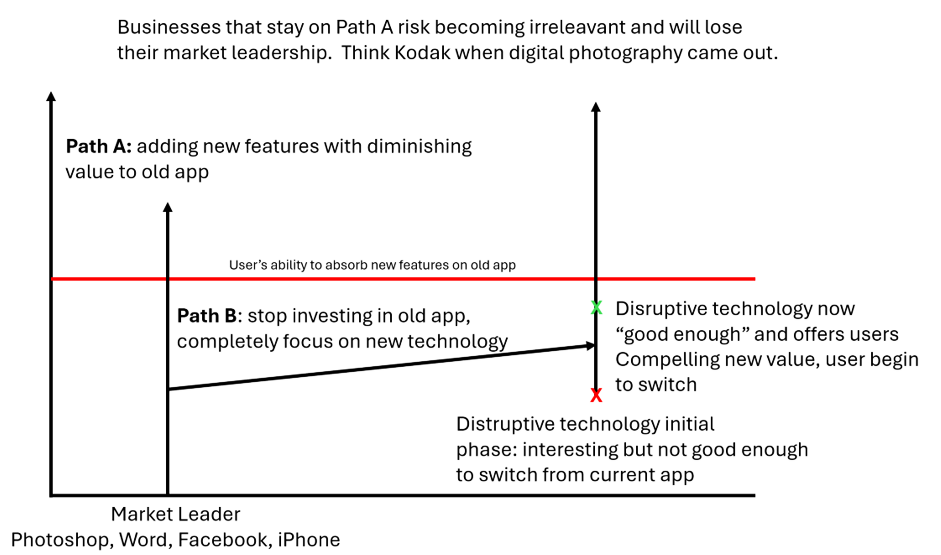
This pattern is not theoretical; we’re already seeing it play out in many areas. Just adding new features to your existing solution has a diminishing rate of return. Most users use only a small fraction of features. How many features do you use daily on your iPhone? On Photoshop, Excel, or Word? There are hundreds of features and shortcuts, but how many do you use?
Today, AI has migrated from the interesting phase to the “good enough” stage. Adobe has decided on Path B. If they had chosen Path A, a new company would launch an app that lets you edit by just typing what you want to do, and it does all the steps for you. People would switch. Adobe would become a niche player, not the market leader.
You are going to see a lot more changes. AI’s capability is moving quickly. I had this picture of two wild horses rearing up in a tiff. The problem was that I had my autofocus on spot and it focused on a horse behind them. That left the intended subjects out of focus.
My first attempt to fix this was a few months ago using Topaz. The software was able to sharpen the two main horses, so they were in focus. However, it significantly over sharpened the background horses. It required hours fixing the over-sharpened horses, and they still just looked weird.
Months went by, and I tried it again. This time Topaz selected the two horses as subject, allowing me to unselect the background horses. Now, the image looks great, and it took less work and time.
The next phase of AI will just let me type “sharpen the two horses rearing up and nothing else.” Now, a photographer does not have to be an expert in the app. They just have to verbalize what they want to do; the app does the rest.
Here is the picture, by the way.

Summary
In summary, AI is a true market disruptor. That is why every company is so focused on it. For us photographers, it will make editing in post much easier. It will also allow non-photographers to easily do the voodoo that we Photoshop experts do.
As AI removes technical barriers, photography becomes less about mastery of tools and more about mastery of vision. The question is no longer whether AI will change photography, but whether photographers are willing to change with it.